
How Long Does It Take to Pave a Concrete Driveway? Common Questions Answered
When homeowners plan a driveway upgrade, one of the first questions they ask is, “How long does it take to pave a concrete driveway?” Understanding the timeline is important because it helps you manage expectations, minimize disruptions, and plan around construction activities. Whether you’re preparing your home for resale, improving curb appeal, or replacing an aging driveway, knowing the exact steps and timeframe can help you make confident decisions.
At Commonwealth Paving, located at 136 Outer Loop, Louisville, Kentucky 40214, homeowners regularly ask this very question. As a trusted local paving provider, our team offers clear guidance based on decades of professional experience in driveway construction. In this guide, you’ll learn every major stage of the concrete driveway installation process, the average time required, and the factors that can speed up—or delay—your project. If you’re planning a concrete driveway soon, this timeline will give you the clarity you need.
Why Timeline Matters for Concrete Driveway Installation
Concrete is a durable, long-lasting, and visually clean surface, but it requires proper installation and curing time. Unlike asphalt, concrete isn’t ready for use within a couple of days. Installing a concrete driveway involves site preparation, forming, pouring, finishing, and extensive curing.
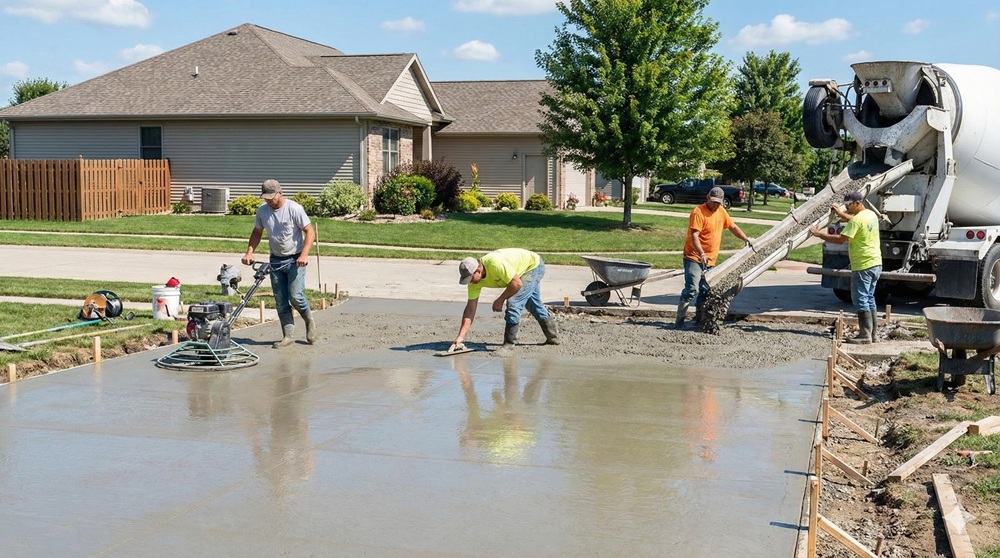
The construction process itself may be completed quickly, but the curing period is what most homeowners underestimate.
Knowing how long it takes to pave a concrete driveway ensures you:
- Avoid planning vehicle deliveries too soon
- Prevent accidental damage to the fresh surface
- Budget time for landscaping or additional hardscaping
- Understand the project from start to finish
With proper installation, your driveway can last 30–40 years or more, making every day of the process worth it.
How Long Does It Take to Pave a Concrete Driveway?
The average timeframe to pave a concrete driveway ranges from 7 to 14 days, depending on project size, site conditions, and curing requirements.
To break it down simply:
- Construction time: 2–5 days
- Initial curing (no walking): 24–48 hours
- Light vehicle use: After 7 days
- Full curing (maximum strength): 28–30 days
Now let’s go deeper into each stage so you understand what to expect on your property.
1. Planning & Measurements (1 Day)
Once you contact Commonwealth Paving at +1 502 459 7283, the first step is an on-site assessment. This includes:
- Measuring driveway dimensions
- Evaluating grading and slope
- Checking soil conditions
- Designing water drainage routes
- Assessing tree roots or underground utilities
This step usually takes a few hours to a full day, depending on complexity.
2. Excavation & Site Preparation (1–2 Days)
Site prep is one of the most important factors determining how long it takes to pave a concrete driveway. Proper ground preparation ensures your driveway does not crack prematurely.
Preparation Steps Include:
- Removing old pavement or grass
- Excavating the soil to the correct depth
- Compacting the subgrade
- Adding a gravel base and leveling it
- Ensuring correct drainage slope
If your driveway area is large or the soil is soft, site preparation may take up to 2 days.
3. Forming & Reinforcement (1 Day)
Before concrete is poured, contractors install forms—wooden or metal frames that outline the driveway shape.
Reinforcement includes:
- Steel rebar
- Wire mesh
- Expansion joints
This step helps prevent cracking and provides long-term structural strength. Forming and reinforcement usually take one full workday.
4. Concrete Pouring (1 Day)
Concrete pouring is typically completed in a single day, depending on the size of the project and weather conditions.
During this stage:
- Concrete is mixed and transported to the site
- Workers pour it evenly within the forms
- The surface is leveled using tools such as screeds and floats
- Edges and joints are shaped precisely
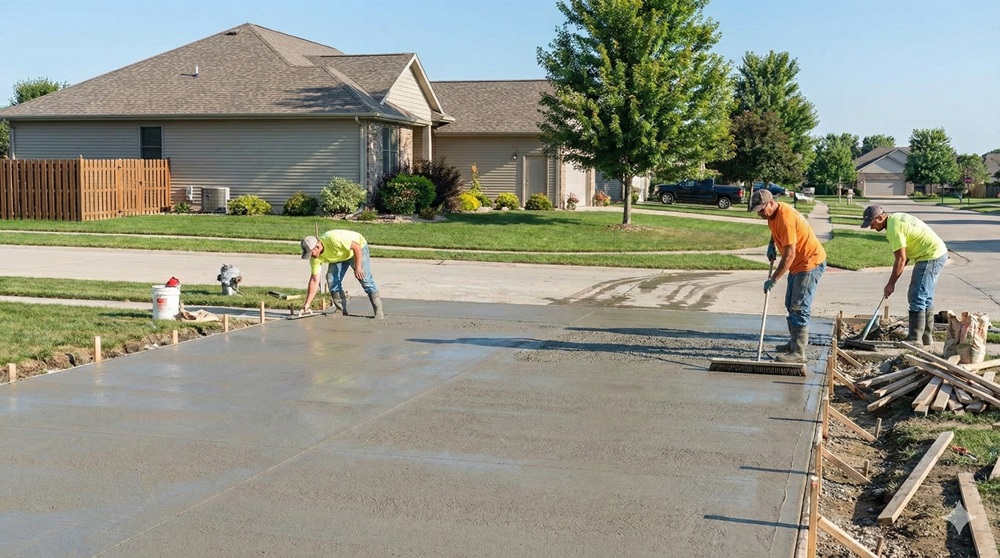
- The surface finish (broom or smooth) is applied
Because concrete begins curing as soon as it’s poured, the crew must work efficiently to ensure a smooth and durable finish.
5. Initial Curing (24–48 Hours)
This is the stage where homeowners often ask:
“Can I walk on it right away?”
Concrete needs 24–48 hours before it can handle foot traffic. During this time, the driveway must be kept:
- Moist
- Unobstructed
- Free from heavy vibrations
- Protected from rain or extreme heat
Early curing is essential to prevent cracking and surface imperfections.
6. Vehicle-Ready Curing (7 Days)
The next common question is:
“How long until I can park my car on it?”
While concrete feels solid within a couple of days, it does not reach safe load-bearing strength until approximately 7 days.
Light vehicles such as sedans or motorcycles can usually be allowed at this stage. However, heavy vehicles—like trucks, RVs, or construction equipment—should be avoided.
7. Full Curing (28–30 Days)
Concrete reaches full compressive strength at around 28 days.
This is when the driveway becomes durable enough to handle:
- Multiple vehicles
- Heavy SUVs
- Occasional service trucks
- Temperature fluctuations
Even though the driveway is usable after a week, the remaining curing time is crucial for maximizing lifespan.
Factors That Affect the Timeline
1. Weather Conditions
Temperature and humidity influence curing time.
Weather that slows the project:
- Heavy rain
- Freeze–thaw temperatures
- Extreme heat
- High humidity
Concrete cures fastest in mild, dry weather.
2. Size of the Driveway
A 1,000 sq. ft. driveway takes longer to prepare and pour than a 400 sq. ft. one.
Larger driveways also require:
- More reinforcement
- More concrete trucks
- More finishing time
3. Soil & Ground Conditions
Poor or clay-heavy soil requires:
- Extra excavation
- Additional gravel base
- Extra compaction
This can add 1–2 days to the project.
4. Design Complexity
Driveways with curves, decorative borders, or special finishes may extend the timeline. Features like stamped concrete or color additives also require more skill and drying time.
5. Access & Equipment Needs
If the driveway has limited access due to fences, landscaping, or narrow passages, it takes longer to bring in equipment and materials.
Timeline Summary: From Start to Finish
Here is a simplified version of how long it takes to pave a concrete driveway:
| Stage | Time Required |
|---|---|
| Measurement & Planning | 1 day |
| Excavation & Site Prep | 1–2 days |
| Forms & Reinforcement | 1 day |
| Concrete Pouring | 1 day |
| Initial Curing | 1–2 days |
| Vehicle-Ready Strength | 7 days |
| Full Curing | 28–30 days |
Total: 7–14 days for installation + 28 days for full curing
Why Choose Commonwealth Paving for Your Concrete Driveway?
Concrete driveway installation is not just a construction job—it’s a long-term investment in your home. That’s why choosing experienced professionals matters.
Commonwealth Paving, located at 136 Outer Loop, Louisville, Kentucky 40214, provides:
- Accurate project timelines
- Professional site preparation
- High-quality reinforcement
- Durable finishes
- Clear communication throughout the process
- Precision workmanship backed by experience
Homeowners trust Commonwealth Paving for reliable service, strong results, and a timeline that stays on track.
For questions or to schedule your driveway project, call +1 502 459 7283.
So, how long does it take to pave a concrete driveway?
In most cases, you can expect the complete installation process to take between 7 and 14 days, with full curing achieved after 28–30 days.
While the timeline depends on factors like weather, design, soil condition, and driveway size, working with a skilled team like Commonwealth Paving ensures accuracy, structural strength, and long-lasting results.
A concrete driveway may take some time to install, but once complete, it becomes one of the most durable and visually appealing upgrades you can make to your home.
If you’re ready to begin your project or want a customized estimate based on your property, call Commonwealth Paving at +1 502 459 7283 today.
How Long Does It Take to Pave a Concrete Driveway? Complete Timeline Guide
If you’re planning a concrete driveway installation, one of the first questions that naturally comes to mind is: How long does it take to pave a concrete driveway? Whether you’re upgrading an aging surface, improving curb appeal, or preparing your home for resale, understanding the complete timeline can help you plan smoothly, avoid unnecessary disruptions, and ensure long-lasting results.
At Commonwealth Paving, located at 136 Outer Loop, Louisville, Kentucky 40214, homeowners ask this question more than any other. Installing a concrete driveway is an investment—not just in money, but in time—and knowing what to expect makes the entire experience stress-free. This guide breaks down every step of the process, from site preparation to full curing, and explains the factors that affect the schedule so you can make informed decisions for your home.
Why the Timeline Matters
Concrete offers unmatched durability, visual appeal, and long-term value. But unlike asphalt, which can often be completed and driven on within a couple of days, concrete has a longer curing and preparation process. The timeline is worth understanding because it affects:
- When you can park your car
- How you schedule your week
- When deliveries or guests can arrive
- How soon you can return to normal routines
Proper timing directly affects the strength, appearance, and lifespan of your driveway. Done correctly, a concrete driveway can last 30–40 years, and the installation timeline plays a major part in that longevity.
So, How Long Does It Take to Pave a Concrete Driveway?
The short answer: Most driveways take 7–14 days to install, plus about 28 days for full curing.
Here’s the typical breakdown:
- Planning & measurements: 1 day
- Excavation and site prep: 1–2 days
- Forming and reinforcement: 1 day
- Concrete pouring: 1 day
- Initial curing (no foot traffic): 24–48 hours
- Light vehicle use: After 7 days
- Full curing: 28–30 days
Now, let’s walk through what actually happens in each stage, so you fully understand the timeline.
Stage 1: Planning, Inspection & Measurements (1 Day)
Before any installation begins, the experts at Commonwealth Paving will visit your property and evaluate several important factors:
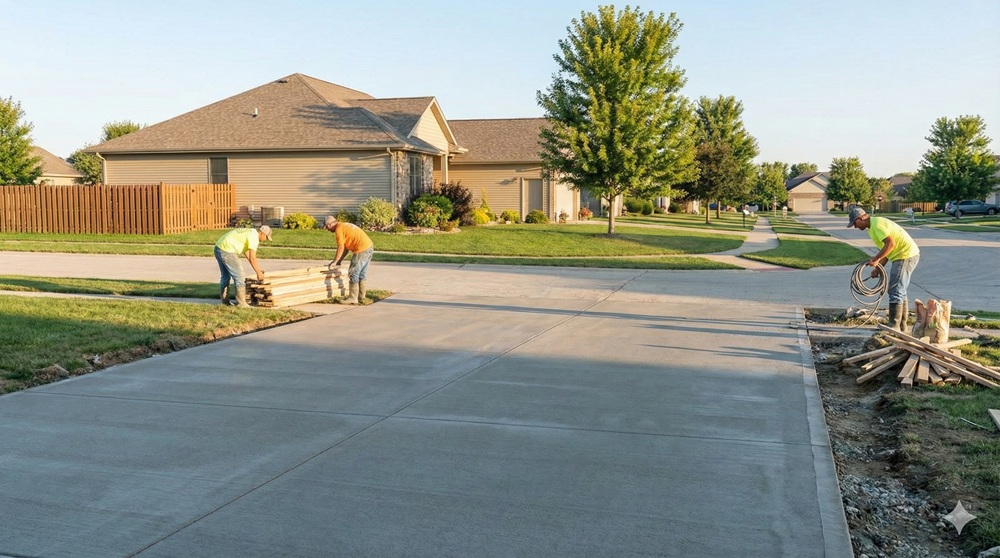
- Driveway dimensions and layout
- Soil conditions
- Slope and drainage
- Existing pavement or grass
- Access for machinery
This evaluation ensures the driveway is designed correctly from the start. Poor planning is one of the most common reasons for cracks and drainage issues later on, so this stage is essential—even if it seems simple.
A typical assessment and measurement appointment takes around one day.
Stage 2: Excavation & Site Preparation (1–2 Days)
Site preparation is one of the most important factors that influences how long it takes to pave a concrete driveway. In many cases, this stage determines whether your driveway lasts decades or develops early cracking.
What happens during site preparation:
- Removing the old driveway (if needed)
- Excavating soil to the proper depth
- Compacting the subgrade for stability
- Adding and leveling a gravel base
- Ensuring proper water drainage slope
If the soil is too soft, clay-heavy, or unstable, additional gravel or deeper excavation may be required. This can add extra time, but it’s necessary to guarantee durability.
On average, this phase takes 1–2 days, depending on the size of your driveway and the condition of the existing ground.
Stage 3: Building Forms & Reinforcement (1 Day)
Next, the installation team sets up wooden or metal forms around the edges of the future driveway. These forms outline the exact shape, edges, and thickness of the concrete slab. Proper formwork ensures the driveway stays straight and maintains the correct slope.
Reinforcement may include:
- Steel rebar
- Wire mesh
- Control joints
- Expansion joints
These reinforcements help the concrete handle weight, seasonal temperature changes, and long-term wear.
This step usually takes a full day, though more detailed projects may require additional hours.
Stage 4: Pouring & Finishing the Concrete (1 Day)
This is the day everything comes together. Concrete is usually poured in a single continuous session to maintain uniformity and avoid cold joints.
The process includes:
- Delivering concrete to the site
- Filling the forms evenly
- Screeding (leveling the concrete)
- Floating and smoothing
- Creating edges and joints
- Applying a broom or smooth finish
Weather plays a major role here. Concrete should not be poured in:
- Torrential rain
- Freezing temperatures
- Extremely hot conditions
If weather isn’t cooperative, the pouring day may be adjusted to ensure the best outcome.
For most homes, pouring the driveway takes one day.
Stage 5: Initial Curing (24–48 Hours)
One of the most common homeowner questions is:
“How soon can I walk on my new driveway?”
After the concrete is poured, the initial curing stage begins. The surface is extremely vulnerable during this time.
Within 24–48 hours:
- It becomes firm enough for light foot traffic
- The surface begins to harden
- The driveway must be kept free of debris, weather damage, or heavy stress
Professionals often apply moisture-control methods like curing blankets or water misting to prevent premature drying or cracking.
Stage 6: Light Vehicle Use (After 7 Days)
The next big question people ask is:
“When can I park my car on it?”
Concrete may appear solid, but it won’t reach safe load-bearing strength until around day 7. At this point, a typical passenger car is safe to park on the driveway.
However, heavy vehicles such as trucks, moving vans, or RVs must be avoided until full curing is complete.
This is why understanding how long it takes to pave a concrete driveway is so important—using it too soon can undo all the careful preparation done earlier.
Stage 7: Full Curing (28–30 Days)
Concrete reaches maximum compressive strength at around 28 days. This is when the driveway becomes fully durable and resistant to seasonal weather changes.
At this point:
- Heavy vehicles can use the driveway
- Landscaping can be completed around the edges
- Sealants (if desired) can be applied
Even though you’ll be driving on it within a week, the full curing period is essential for the driveway’s long-term strength.
Factors That Affect the Timeline
Even with a structured schedule, several variables can influence how long it takes to pave a concrete driveway. Understanding these helps you set realistic expectations.
1. Weather Conditions
Weather is the biggest variable. Optimal conditions are mild and dry. Rain or freezing temperatures can delay:
- Pouring
- Finishing
- Curing
In extreme heat, concrete dries too quickly, which may require tents, water misting, or accelerators.
2. Driveway Size & Thickness
A wide or long driveway adds more:
- Excavation work
- Gravel preparation
- Material volume
- Finishing time
Larger projects require more days.
3. Soil Quality
Unstable or moisture-heavy soil must be corrected before pouring. This can add anywhere from hours to multiple days depending on conditions.
4. Design Details
Driveways with curves, decorative borders, stamped patterns, or colored concrete take longer to set up and finish.
5. Access to the Work Area
Limited access slows down:
- Machinery movement
- Material delivery
- Excavation
- Pouring efficiency
Homes with narrow passageways or complex landscaping may require more time for setup.
Timeline Summary
Here’s a quick recap of the complete process:
| Stage | Average Time |
|---|---|
| Planning & Measurement | 1 day |
| Excavation & Site Prep | 1–2 days |
| Forms & Reinforcement | 1 day |
| Concrete Pouring | 1 day |
| Initial Curing (Foot Traffic) | 24–48 hours |
| Light Vehicle Use | After 7 days |
| Full Curing | 28–30 days |
Total installation timeframe: 7–14 days
Full curing completion: 28–30 days
Why Choose Commonwealth Paving for Your Concrete Driveway?
If you want professional workmanship, accurate timelines, and long-lasting results, working with the right paving contractor makes all the difference.
Commonwealth Paving, located at 136 Outer Loop, Louisville, Kentucky 40214, provides:
- Expert assessment of your property
- Precise grading and slope solutions
- Strong reinforcement techniques
- High-quality concrete finishing
- Clear communication throughout the project
- Reliable scheduling
- Durable, long-lasting driveway construction
For questions or to schedule your driveway installation, call +1 502 459 7283 anytime.
So, how long does it take to pave a concrete driveway? The full process typically takes 7 to 14 days, with your driveway reaching full strength at around 28–30 days. This timeline allows for proper preparation, precise installation, and thorough curing—three essential ingredients for a surface that lasts decades.
Concrete driveways offer beauty, strength, and long-term value, and with the right professionals, the process becomes smooth and stress-free.
If you’re ready to begin your project or want expert guidance specific to your home, reach out to Commonwealth Paving at +1 502 459 7283.
Address
Commonwealth Paving, 136 Outerloop, Louisville, Kentucky 40214
Phone: 502-459-7283, Fax: 502-456-2678
Opening Hours
| Monday | 9:00 AM – 5:00 PM |
| Tuesday | 9:00 AM – 5:00 PM |
| Wednesday | 9:00 AM – 5:00 PM |
| Thursday | 9:00 AM – 5:00 PM |
| Friday | 9:00 AM – 5:00 PM |
| Saturday | Closed |
| Sunday | Closed |