
How to Install Artificial Grass Strips Between Pavers for Driveways & Patios
Designing a modern driveway or patio is no longer just about choosing sturdy materials—it’s about creating a functional space that looks beautiful, too. One of the fastest-growing trends in landscape design is adding artificial grass strips between pavers. Homeowners love this technique because it offers an elegant, clean, and eco-friendly look without the maintenance hassles of natural grass. If you are wondering “How to Install Artificial Grass Strips Between Pavers”, this detailed guide will walk you through the entire process step-by-step. Whether you’re updating your driveway, refreshing your patio, or designing a brand-new outdoor space, this method adds charm and sophistication.
At Commonwealth Paving, located at 136 Outer Loop, Louisville, Kentucky 40214, we help homeowners and commercial property owners achieve stunning, durable surfaces. If you need installation support, expert guidance, or a complete paving solution, our team is always ready to assist at +1 502 459 7283.
Why Choose Artificial Grass Strips Between Pavers?
1. Zero Maintenance
Unlike natural grass, artificial turf never needs watering, mowing, fertilizing, or weeding. Once installed, your space stays green year-round.
2. Enhances Curb Appeal
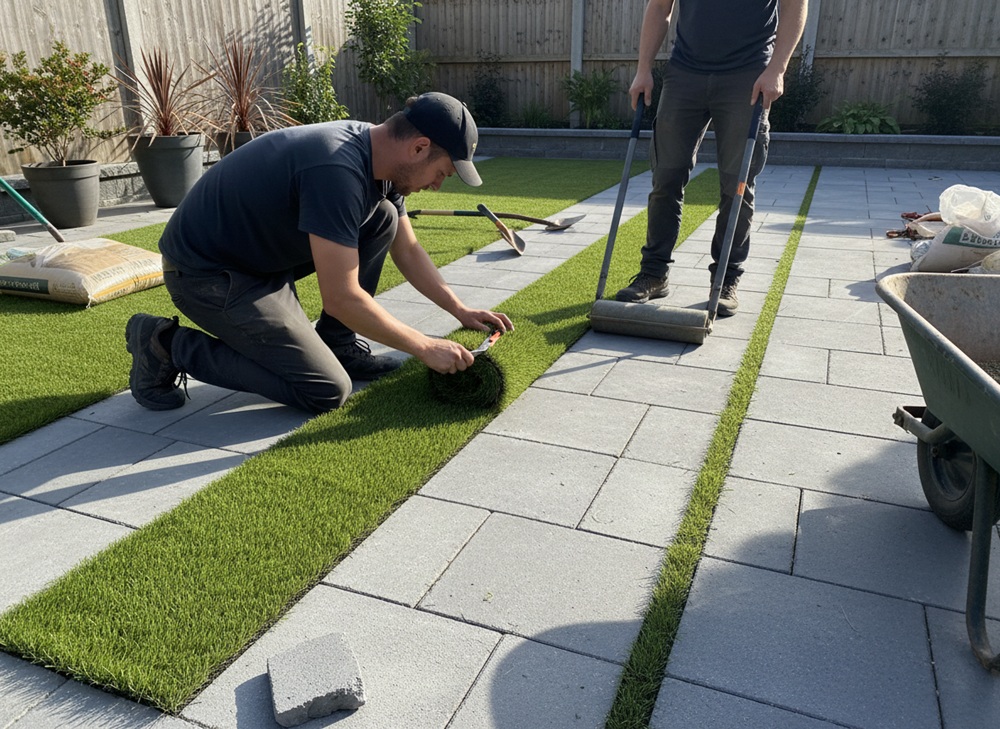
Artificial grass lines create a beautiful contrast alongside concrete, brick, or stone pavers. The visual symmetry and the crisp green edges add a modern, luxurious look.
3. Ideal for Both Driveways and Patios
The method works seamlessly in:
- Residential driveways
- Walkways
- Backyard patios
- Poolside spaces
- Garden paths
4. Long-Lasting Durability
Good-quality artificial turf is weather-resistant, UV-protected, and designed to handle heavy foot traffic—and with the right installation, it can even tolerate driveway vehicle weight.
5. Allows Better Water Drainage
Installing turf strips properly ensures good drainage, preventing puddles, mud, or slippery surfaces.
Step-by-Step Guide: How to Install Artificial Grass Strips Between Pavers
Installing artificial grass between pavers requires precision, preparation, and patience. Below is a detailed, easy-to-follow method approved by the paving experts at Commonwealth Paving.
Step 1: Plan Your Layout
The foundation of successful installation is planning. Measure the total area, decide the spacing between pavers, and map out how wide you want the turf strips to be.
Important points:
- Common strip width: 1″ to 4″
- Ensure uniform spacing
- Consider water flow and drainage patterns
- Choose high-quality turf designed for narrow seams
A well-planned layout ensures your finished driveway or patio looks perfectly aligned and symmetrical.
Step 2: Install or Adjust the Pavers
If you’re working on a new project:
- Lay the pavers first.
- Compact the base properly.
- Allow enough spacing for grass strips.
For an existing driveway or patio:
- You may need to remove joint sand or gravel.
- Create a clean channel for the turf installation.
The spacing between pavers directly affects how the artificial grass will look, so accuracy is key.
Step 3: Clean the Gaps and Prepare the Base
To ensure long-lasting results, the gaps between the pavers must be properly prepared. This step is crucial in How to Install Artificial Grass Strips Between Pavers.
- Remove debris, soil, and old filler material.
- Dig down 2–3 inches to create enough depth for the turf base.
- Compact the soil using a hand tamper.
- Add a thin layer of crushed stone or decomposed granite.
- Compact again to create a stable foundation.
This solid base prevents sinking, uneven strips, and drainage problems.
Step 4: Add a Weed Barrier and Sand Base
Artificial turf can keep weeds away, but installing a weed barrier sheet gives you double protection.
After placing the barrier:
- Add ½ to 1 inch of silica sand
- Level it with a small trowel
- Compact it gently
The sand base helps keep the turf smooth and stable over time.
Step 5: Cut the Artificial Grass into Strips
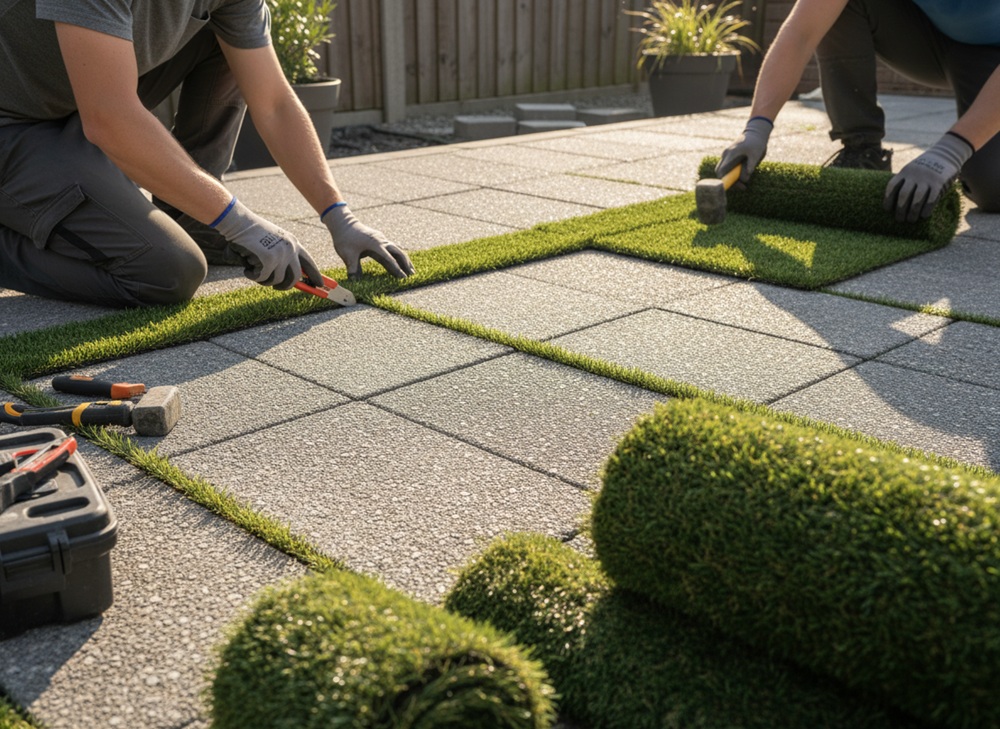
This is one of the trickiest but most important steps. Since paver gaps are narrow, you must cut turf with precision.
Tips for clean strip cutting:
- Always cut from the back of the turf.
- Use sharp utility blades.
- Measure twice before cutting.
- Make sure the turf fibers face the same direction across all strips.
Consistency ensures a clean, professional look.
Step 6: Fit the Turf Strips into the Gaps
Now slide each strip into the paver channels. Make sure:
- The backing sits firmly on the sand base
- The turf edges touch paver walls cleanly
- The grass blades stand upward
A snug fit is essential to prevent movement or wrinkling.
Step 7: Secure the Strips in Place
To prevent shifting:
- Use landscape adhesive on the paver sides
- Apply glue strategically—not excessively
- Press strips down firmly
You may also secure strips with turf nails, depending on the gap width. For driveways where cars drive over strips, adhesive is the better long-term solution.
Step 8: Add Silica Sand Infill (Optional but Recommended)
Brushing a small amount of silica sand into the turf:
- Keeps blades upright
- Adds weight
- Prevents flattening
- Improves durability
Use a soft-bristle brush for even spreading.
Step 9: Final Brushing and Cleanup
Brush the artificial strips upward to fluff the fibers. Clean the pavers and sweep away excess sand or trimming waste. Once done, you’ll have a beautifully finished driveway or patio.
Important Tips for Best Results
Choose the Right Turf
Narrow strips need turf with shorter pile height (around 1″ or less). This ensures they remain upright and visually clean.
Ensure Good Drainage
The base must be compacted and leveled properly. Poor drainage can damage both turf and pavers.
Use Professional-Grade Adhesive
High-quality glue ensures your turf strips stay secure even in harsh Louisville weather.
Avoid Extremely Thick Turf
Thick turf may not fit neatly between pavers and will look uneven.
Common Mistakes to Avoid
Even after understanding how to Install Artificial Grass Strips Between Pavers, many homeowners make these mistakes:
- Cutting turf too wide, causing it to bunch up
- Not compacting the base properly
- Leaving gaps between turf and paver edges
- Using soft or low-quality grass
- Ignoring drainage requirements
- Applying too much glue
Taking your time ensures a flawless finish that lasts for years.
Maintenance After Installation
One of the biggest advantages of artificial turf strips is minimal upkeep. Still, a little care can make your driveway or patio look fresh forever.
- Brush strips occasionally to maintain upright blades
- Rinse to remove dust or pollen
- Inspect edges yearly
- Remove fallen leaves
- Check for any loose sections and re-glue if necessary
With proper installation, these strips remain vibrant and strong for years.
Why Choose Commonwealth Paving for Installation?
Installing artificial grass strips between pavers may look easy, but achieving a neat, professional finish requires expertise. At Commonwealth Paving, our specialists bring decades of experience in driveway and patio construction.
Here’s why Louisville homeowners trust us:
- Perfect measurements and precise cuts
- High-quality turf installation
- Advanced tools and equipment
- Expert drainage planning
- Durable and long-lasting results
- Friendly and reliable service
Our location:
Commonwealth Paving
136 Outer Loop, Louisville, Kentucky 40214
Call us anytime at +1 502 459 7283 for estimates, consultations, or full installation services.
Understanding how to Install Artificial Grass Strips Between Pavers helps you appreciate the craftsmanship behind creating a modern, low-maintenance outdoor space. When executed properly, this method blends beauty with durability and instantly enhances curb appeal.
Whether you’re transforming a driveway, patio, walkway, or garden space, artificial grass strips can completely change the look of your property. If you want the job done with perfection, the team at Commonwealth Paving is ready to help bring your vision to life.
Need expert assistance or want to start your outdoor upgrade?
Call Commonwealth Paving at +1 502 459 7283 today.
How to Install Artificial Grass Strips Between Pavers: Common Mistakes to Avoid
Artificial grass has transformed how homeowners design modern driveways, patios, pathways, and outdoor living areas. Today, one of the most stylish trends in landscaping is installing artificial grass strips between pavers, giving outdoor spaces a clean, luxurious, and eco-friendly finish. However, many homeowners discover that the installation is not as simple as laying turf between concrete blocks. It requires precision, technique, proper materials, and an understanding of what not to do.
If you are searching for expert advice on how to Install Artificial Grass Strips Between Pavers, this in-depth guide focuses on the most common mistakes people make—and how to avoid them. With insights from the experienced team at Commonwealth Paving, located at 136 Outer Loop, Louisville, Kentucky 40214, you’ll learn how to achieve a flawless and long-lasting installation. For help or professional support, you can always contact us at +1 502 459 7283.
Why Homeowners Love Artificial Grass Between Pavers
Artificial grass strips add more than beauty—they enhance the function and durability of your outdoor surfaces. The contrasting colors of lush green turf and hard pavers create a modern design that works well for:
- Driveways
- Patios
- Walkways
- Courtyards
- Garden paths
- Pool surroundings
The look is polished and contemporary, and the best part is the low maintenance. Turf remains green all year without mowing, watering, fertilizing, or dealing with muddy spots.
But even the most beautiful outdoor design can fail if the grass strips are installed incorrectly. Before learning what to avoid, let’s briefly understand what makes the process so delicate.
Installing turf between pavers involves cutting narrow strips, ensuring perfect drainage, securing the turf in place, and creating a solid base. Small mistakes can impact both appearance and longevity.
Common Mistakes to Avoid When Installing Artificial Grass Strips Between Pavers
Homeowners often make the same errors—usually because the installation looks simple on the surface. However, the difference between an amateur job and a professional result lies in avoiding the mistakes explained below.
Mistake #1: Not Preparing the Base Properly
The most important part of learning how to Install Artificial Grass Strips Between Pavers is understanding the base preparation. Poor preparation is one of the biggest reasons turf strips begin sinking, shifting, or developing uneven surfaces.
Many homeowners skip steps like:
- Removing old material
- Digging down to the correct depth
- Adding crushed stone for drainage
- Compacting the base properly
A stable base must be:
- Clean
- Compacted
- Level
- Draining well
If the base is too soft or uneven, the grass strips will never sit correctly, no matter how well they’re cut.
Mistake #2: Choosing the Wrong Type of Artificial Grass
Not all turf works for narrow gaps. In fact, this is one of the most overlooked mistakes.
People often buy thick, long artificial grass meant for lawns, but this type doesn’t fit neatly between pavers. It bulges, bends, and fails to stay upright.
For paver strips, the correct turf should be:
- Short pile (about 1 inch)
- Stiff enough to stand straight
- Durable for foot traffic
- Easy to cut into narrow pieces
Choosing the wrong turf can lead to trimming issues, messy installation, and an unnatural appearance.
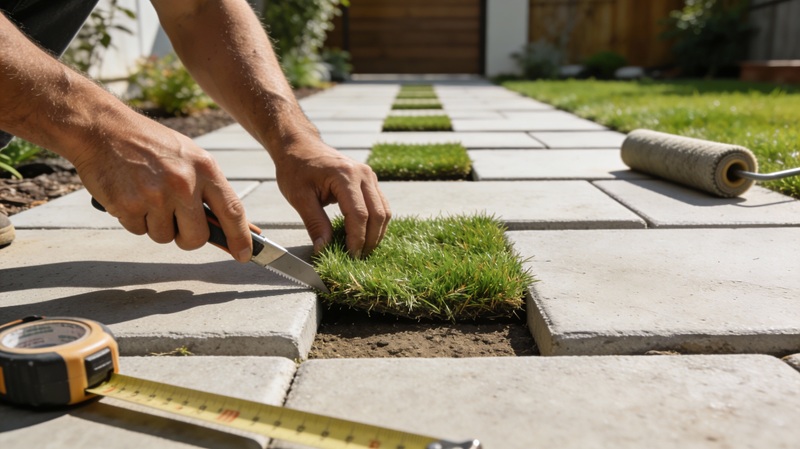
Mistake #3: Cutting Turf Strips Incorrectly
Cutting the artificial grass correctly is a crucial part of how to Install Artificial Grass Strips Between Pavers. Narrow strips require precision—one wrong cut can ruin the entire roll.
Common cutting errors include:
- Cutting from the front instead of the back
- Using dull blades
- Cutting strips too wide or too narrow
- Ignoring the direction of the grass blades
Cutting turf strips that are even 1–2 millimeters inaccurate can prevent them from fitting into paver gaps. Poorly cut edges lead to visible seams or loose edges that peel up over time.
Mistake #4: Failing to Secure the Turf Properly
Once the turf strips are placed, they must be secured so they don’t shift, lift, or loosen.
Some people rely only on sand or pressure to keep them in place. Others use too much adhesive, which creates hard clumps or spills onto the pavers.
The appropriate approach involves:
- Applying strong landscape adhesive in controlled amounts
- Ensuring adhesive touches both the turf backing and paver walls
- Pressing strips firmly to secure them
Driveways especially require stronger adhesive support since tires may pass over the strips.
Mistake #5: Ignoring Drainage Requirements
Artificial turf needs proper drainage to stay clean, odor-free, and stable. The biggest drainage mistakes include:
- Not creating enough slope
- Using the wrong base material
- Letting water pool in the gaps
- Forgetting to compact the base
If water cannot drain, it causes mold growth, foul odors, and erosion beneath the strips. Effective drainage ensures that you won’t deal with mud, sinking, or algae.
Mistake #6: Using Too Much or Too Little Infill
Some homeowners skip infill, thinking the strips are too narrow to need it. Others overload the turf with infill, making it look stiff or unnatural.
Infill should:
- Add weight
- Support blades
- Improve durability
But it must be used lightly—enough to stabilize the turf but not so much that it causes bulging or heaviness.
This is one of the most underrated details in How to Install Artificial Grass Strips Between Pavers, yet it has a huge impact on long-term performance.
Mistake #7: Not Aligning the Direction of Grass Blades
To the untrained eye, it may seem like turf fibers stand straight in every direction. In reality, artificial grass has a “grain,” similar to carpet.
Many homeowners accidentally install strips with the blades facing different directions. This results in:
- Varied shades under sunlight
- Uneven texture
- A mismatched appearance
For a seamless, professional result, all strips must be installed with fibers pointing in the same direction.
Mistake #8: Installing Without Considering Traffic Use
The placement of turf strips should take into account the weight and traffic of the area. For example:
- A driveway needs stronger turf and more adhesive
- A decorative patio may require less reinforcement
- A walkway must support foot pressure without shifting
Ignoring traffic patterns can cause premature wear and tear.
Mistake #9: Rushing Through the Installation
Perhaps the biggest mistake is treating the job as a simple DIY weekend project. Installing turf between pavers requires patience and attention to detail.
Rushing typically leads to:
- Uneven cuts
- Poor adhesion
- Misalignment
- Incomplete base preparation
- Gaps or bulges
Even one poorly installed strip can ruin the entire visual impact.
Tips to Avoid These Mistakes and Achieve a Flawless Finish
Knowing how to Install Artificial Grass Strips Between Pavers means understanding both what to do and what to avoid. Here are some tips to ensure success:
- Use top-quality turf designed for narrow strips
- Make sure the base is compact and drains well
- Measure each gap before cutting
- Cut from the backing side for accuracy
- Keep the blade direction consistent
- Use proper adhesive and apply evenly
- Install during mild weather for better adhesion
- Clean pavers before securing the turf to avoid dust interference
Attention to these details can produce an installation that looks clean, symmetrical, and visually impressive.
Why Professional Installation Makes a Difference
While many homeowners attempt to install turf strips themselves, achieving a sharp, straight, and durable finish often requires professional expertise.
At Commonwealth Paving, our experience with driveways, patios, and hardscape design allows us to install artificial grass strips with exceptional precision. We understand drainage, base preparation, paver spacing, and turf alignment—skills that come only from hands-on experience.
Homeowners trust us because we deliver:
- Perfectly cut strips
- Fully prepared bases
- Proper drainage solutions
- High-quality adhesive application
- Clean edges and consistent alignment
- Durability built for Kentucky weather
If you need help designing or installing your artificial grass strip project, our team at Commonwealth Paving is always ready to assist.
Visit us at:
136 Outer Loop, Louisville, Kentucky 40214
Call anytime:
+1 502 459 7283
Knowing how to Install Artificial Grass Strips Between Pavers is essential, but understanding the common mistakes to avoid is what brings truly professional results. Whether you’re enhancing your driveway, patio, walkway, or a custom outdoor space, the combination of pavers and artificial grass creates a clean and modern look that elevates any property.
Avoiding the errors described above will help you achieve a long-lasting, beautiful installation that stays vibrant for years. Proper preparation, correct materials, and attention to detail are the keys to success.
If you ever feel unsure about the installation process or want guaranteed perfection, the experts at Commonwealth Paving are just one call away at +1 502 459 7283. With our experience and commitment to quality, we can help you create a stunning outdoor space that stands out in both beauty and durability.
Address
Commonwealth Paving, 136 Outerloop, Louisville, Kentucky 40214
Phone: 502-459-7283, Fax: 502-456-2678
Opening Hours
| Monday | 9:00 AM – 5:00 PM |
| Tuesday | 9:00 AM – 5:00 PM |
| Wednesday | 9:00 AM – 5:00 PM |
| Thursday | 9:00 AM – 5:00 PM |
| Friday | 9:00 AM – 5:00 PM |
| Saturday | Closed |
| Sunday | Closed |