
How Long Does It Take to Pave a Concrete Driveway for Residential Homes?
When homeowners begin planning a new driveway, one of the first questions they ask is: “How long does it take to pave a concrete driveway?”
Timing matters. Your driveway is an essential part of your home’s functionality, curb appeal, and smooth day-to-day living. Whether you’re building a brand-new driveway or replacing an aging one, knowing how long the process takes helps you prepare for construction, schedule parking arrangements, and avoid unnecessary disruptions.
At Commonwealth Paving, located at 136 Outer Loop, Louisville, Kentucky 40214, homeowners frequently call +1 502 459 7283 to discuss timelines before starting their concrete driveway project. While concrete is known for its durability and long lifespan, it does require a more time-intensive installation and curing process.
This comprehensive guide explains how long it takes to pave a concrete driveway for residential homes, the stages involved, and the factors that influence the overall timeline.
Why Understanding the Concrete Driveway Timeline Matters
Paving a driveway isn’t just a construction task—it’s a temporary but important disruption. You may need to park elsewhere, avoid using your garage for several days, and adapt to noise or equipment on your property. Understanding how long it takes to pave a concrete driveway allows you to:
- Prepare your household in advance
- Avoid scheduling conflicts
- Plan for weather considerations
- Make arrangements for long curing periods
- Ensure smooth and safe installation
Unlike some materials, concrete requires time not just for installation but for proper curing. If rushed, curing mistakes can shorten the life of your driveway or cause early cracking. That’s why professional teams like Commonwealth Paving guide homeowners carefully through the entire process.
Step-by-Step Timeline for Paving a Concrete Driveway
Below is a clear breakdown of the major stages involved in paving a concrete driveway and how long each step takes. When combined, they provide a full picture of how long it takes to pave a concrete driveway from start to finish.
1. Site Evaluation & Planning (1–2 Days)
Every successful driveway project starts with a careful site evaluation. This includes:
- Measuring the driveway area
- Checking soil conditions
- Assessing old pavement (if any)
- Evaluating water drainage patterns
- Identifying slopes and grade levels
- Planning formwork and reinforcement needs
This step helps prevent drainage issues, surface cracks, or uneven settling in the future. Typically, this evaluation takes one to two days, depending on the complexity of the driveway layout.
2. Removal of Existing Driveway (1–2 Days)
If your old driveway needs to be replaced, removal becomes the first major phase of work. It involves:
- Breaking up old concrete or asphalt
- Hauling away debris
- Excavating unstable soil
- Preparing the sub-base area
A standard residential driveway can usually be removed within one day, but larger or reinforced concrete slabs may require up to two days. When homeowners ask how long it takes to pave a concrete driveway, removal time is an important part of that answer.
3. Excavation & Base Preparation (1–3 Days)
The base is the foundation of your driveway. Poor preparation here leads to future cracking, sinking, or drainage problems. Base preparation includes:
- Digging out soft soil
- Laying crushed stone or gravel
- Compacting the base for stability
- Rechecking grade slopes
Base preparation generally takes one to three days, depending on soil condition and the driveway’s size.
This stage has one of the biggest impacts on how long it takes to pave a concrete driveway because no further steps can begin until the sub-base meets strict stability requirements.
4. Formwork Installation (1 Day)
To install concrete properly, durable wooden or metal forms must be placed around the entire driveway. Formwork creates:
- Clean, defined edges
- A barrier to hold wet concrete in place
- Consistent thickness throughout the slab
In most residential projects, formwork takes about one day.
5. Reinforcement Installation (Same Day as Formwork)
Depending on the design, reinforcement may include:
- Steel rebar
- Wire mesh
- Expansion joints
Reinforcements help control cracking and improve load distribution. This step is often completed on the same day as formwork or the following day, adding minimal time to the overall schedule.
6. Concrete Pouring (1 Day)
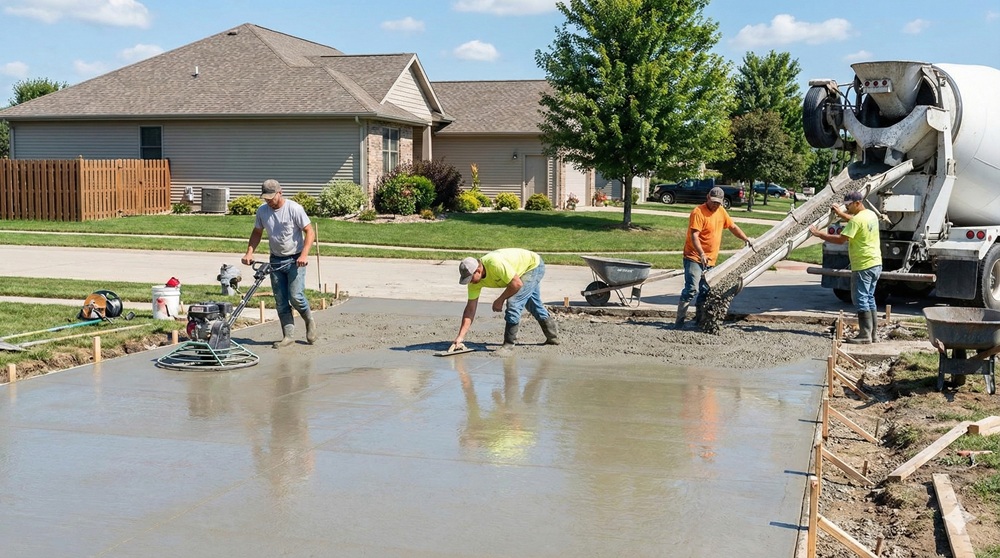
Pouring concrete is the most dramatic part of the process. Fresh concrete arrives, is poured into the forms, leveled, and smoothed. This includes:
- Spreading and screeding
- Power troweling
- Surface finishing
- Edge trimming
A skilled crew from Commonwealth Paving typically completes the pour in one day, although very large or complex driveways might take slightly longer.
7. Initial Set Time (24–48 Hours)
Once poured, concrete begins the early stage of curing known as the “initial set.” During this time:
- The surface must be protected from rain, footprints, and pets
- No one should walk on it for at least 24 hours
- You may need to cover it if temperatures drop unexpectedly
Although the concrete begins to harden quickly, it is extremely vulnerable during this time.
8. Early Curing Period (2–7 Days)
Even after initial set, concrete is nowhere near ready for vehicle traffic. While you may be able to walk on it lightly after 48 hours, you must avoid driving or placing heavy objects on it.
During this early curing period:
- Moisture levels stabilize
- Concrete gains initial compressive strength
- Surface becomes more resilient
Most homes require 3–7 days before light vehicles are allowed onto the concrete.
This stage is one of the biggest contributors to how long it takes to pave a concrete driveway.
9. Full Cure Time (21–28 Days)
Concrete reaches its full strength after approximately 28 days. During this time:
- Expansion joints settle
- Moisture evaporates
- Concrete becomes stable and long-lasting
While you don’t need to wait the full 28 days to use your driveway, heavy vehicles, dumpsters, or construction equipment should not be placed on it until the curing process is complete.
Total Installation Timeline: How Long Does It Take to Pave a Concrete Driveway?
When combining all stages, a typical residential concrete driveway installation takes:
7 to 14 days for installation
and
21 to 28 days for complete curing.
So the answer to “how long does it take to pave a concrete driveway?” is:
➡ Around 1–2 weeks for active installation
➡ Around 1 month for complete curing
This timeline ensures maximum strength, durability, and long-term performance.
Factors That Influence the Installation Timeline
Although most concrete driveway projects follow the general timeline, specific factors can extend or shorten the process:
Weather Conditions
Concrete is sensitive to extreme temperatures, rain, and humidity. Wet or freezing weather can delay pouring or extend curing.
Driveway Size
Larger areas require more grading, more reinforcement, and more concrete.
Soil Conditions
Unstable, clay-heavy, or wet soil often requires additional sub-base work.
Property Layout
Curved driveways, steep slopes, or limited truck access will increase time.
Thickness and Strength Requirements
Thicker slabs take longer to pour and cure.
Professional evaluation from Commonwealth Paving ensures an accurate timeline customized for your property.
How Homeowners Can Prepare for the Project
A smooth timeline requires proper planning. Here are simple steps you can take:
- Remove vehicles from the driveway and garage
- Trim landscaping that blocks construction equipment
- Plan alternative parking for at least a week
- Keep pets and children away from the work area
- Monitor weather updates
- Prepare for curing restrictions
Being ready helps ensure no delays extend your project.
Why Concrete Takes Longer Than Asphalt
Many homeowners compare concrete to asphalt. In general:
- Asphalt can be used within 1–3 days
- Concrete requires 7–28 days
Concrete’s extended curing time gives it exceptional strength, but it also demands patience. If your priority is long-term durability and a clean, polished look, concrete remains a strong option—but the timeline is undeniably longer.
Why Professional Installation Matters
Concrete driveway paving requires experience, precision, and proper equipment. Mistakes in grading, pouring, or curing can lead to:
- Premature cracks
- Surface scaling
- Drainage issues
- Weak concrete strength
- Uneven settling
Professional teams like Commonwealth Paving eliminate these risks by handling every stage with skill and industry knowledge. With years of experience installing driveways across Louisville and surrounding communities, the team provides:
- Accurate timelines
- Smooth communication
- Quality workmanship
- Proper curing procedures
- Long-lasting, durable results
Homeowners can reach the team anytime at +1 502 459 7283 for guidance, scheduling, or a personalized estimate.
So, how long does it take to pave a concrete driveway for residential homes?
The complete timeline—including preparation, pouring, early curing, and full curing—ranges from one week to one month, depending on various project factors.
Concrete takes longer than some other materials, but its durability, strength, and lifespan make the investment worthwhile. Understanding the timeline helps you plan effectively, avoid surprises, and maintain your daily routine with minimal disruption.
If you’re ready to begin your concrete driveway project, Commonwealth Paving, located at 136 Outer Loop, Louisville, Kentucky 40214, is here to help. Contact their toll-free number +1 502 459 7283 for expert guidance and a detailed estimate tailored to your home.
A strong, beautifully paved concrete driveway is worth the wait—and with the right team, the process is smooth from start to finish.
How Long Does It Take to Pave a Concrete Driveway? Professional vs. DIY Timeframes
If you’re planning a new concrete driveway, one of the first questions you’re likely asking is: “How long does it take to pave a concrete driveway?” Time matters—especially when the driveway is your main entry point, your parking surface, and an essential part of your property’s curb appeal. Homeowners often underestimate the steps involved in concrete driveway construction, but understanding the timeline helps set realistic expectations and avoids surprises.
At Commonwealth Paving, located at 136 Outer Loop, Louisville, Kentucky 40214, homeowners regularly ask about project duration, scheduling needs, curing periods, and how different approaches affect the total time. Whether you’re considering hiring professionals or thinking about handling parts of the project yourself, the timeline can vary dramatically.
In this detailed guide, we break down professional vs. DIY timeframes, the stages of concrete driveway paving, what factors influence duration, and how long you’ll need to wait before driving on your new surface. By the end, you’ll know exactly what to expect—and why relying on a trusted team like Commonwealth Paving (+1 502 459 7283) can make all the difference.
Understanding the Full Timeline of a Concrete Driveway Installation
Most homeowners have a general idea that concrete needs time to cure, but the process involves more than just pouring and waiting. When asking how long does it take to pave a concrete driveway, you’re really asking about the combined timeline of:
- Planning
- Ground preparation
- Framing
- Pouring
- Finishing
- Curing and sealing
Even minor delays—such as weather or drainage issues—can change the project duration significantly.
Generally:
- Professional installation: 5–10 days (not including full curing)
- DIY installation: 2–4 weeks or more, depending on experience
- Curing for vehicle traffic: Approximately 7–30 days
But these numbers only scratch the surface. Let’s look at each approach.
Professional Driveway Installation Timeframe
When you hire experts like Commonwealth Paving, each stage is streamlined, organized, and completed using commercial-grade tools and equipment. The efficiency, precision, and experience eliminate much of the trial-and-error delay that homeowners face with DIY projects.
Below is a realistic timeline for professional installation.
1. Site Evaluation and Planning (1 Day)
Professionals begin with:
- Measuring the area
- Checking soil stability
- Inspecting drainage
- Assessing slope
- Determining base requirements
This step is fast because professionals know exactly what to look for. They also bring years of experience handling Louisville soil conditions, weather patterns, and residential driveway standards.
2. Excavation and Base Preparation (1–2 Days)
Preparing a strong foundation is essential for driveway longevity.
This stage includes:
- Removing existing pavement, grass, or soil
- Excavating 6–12 inches (depending on soil type)
- Installing a gravel base
- Compacting the surface with heavy equipment
Professionals complete this step quickly because they have:
- Excavators
- Grading machines
- Industrial compactors
This part often takes the average DIY homeowner three to seven days on their own.
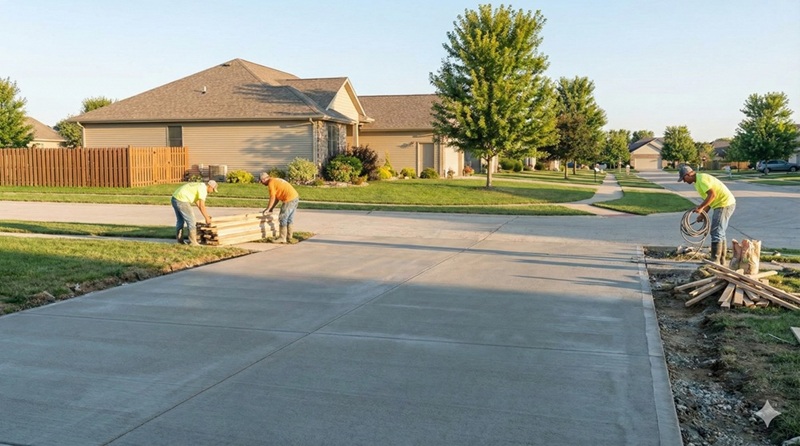
3. Installing Forms and Reinforcement (1 Day)
Once the base is complete, the team builds sturdy forms around the driveway using wood or metal. Reinforcement—usually steel rebar or wire mesh—is placed to strengthen the concrete.
A professional team completes this in a few hours. For DIY installers, this step often takes days because:
- Forms must be perfectly aligned
- Any mistake affects the entire driveway’s structure
- Reinforcement has to be installed correctly to prevent cracking
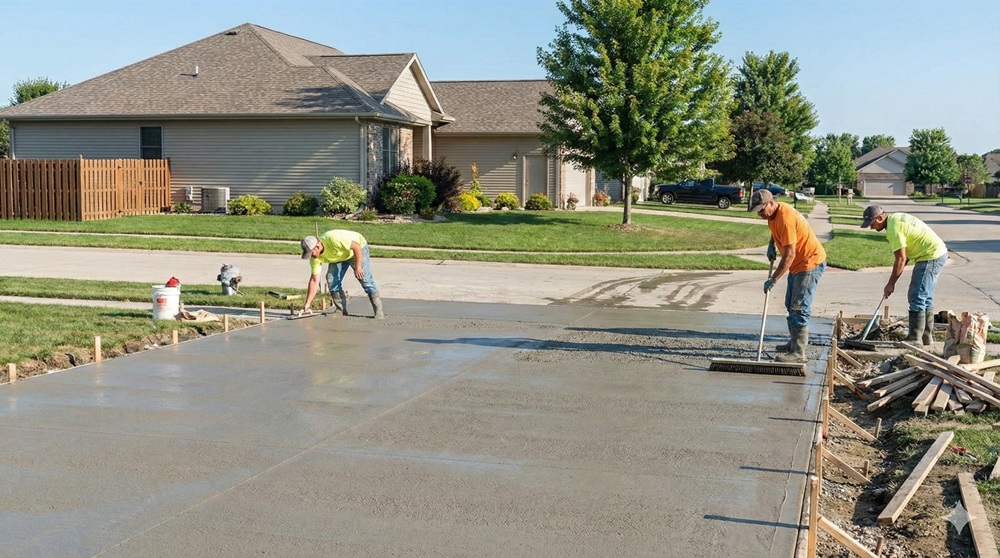
4. Pouring the Concrete (1 Day)
Professionals pour the concrete in a single, continuous process for structural integrity.
Professional advantages:
- Transit-mix concrete trucks
- Power screeds
- Finishing machines
- Large crews to keep concrete workable
DIY homeowners typically take much longer because they often rent smaller mixers that require multiple batches—risking uneven curing, cold joints, and visible texture differences.
5. Finishing Work (Same Day as Pouring)
Professional finishing includes:
- Leveling
- Smoothing
- Adding texture for slip-resistance
- Edge detailing
- Control joints to reduce cracking
This step affects both appearance and durability, and experts complete it quickly because they work while the concrete is still at the proper consistency.
6. Initial Curing (24–48 Hours)
After pouring, the driveway needs time to set before you can walk on it.
Professionals may use:
- Curing compounds
- Moisture-retention blankets
- Surface treatments
This ensures the concrete strengthens consistently.
7. Full Curing and Final Use (7–30 Days)
Concrete reaches:
- 70% strength in 7 days
- 100% strength in approximately 28–30 days
Most professionals recommend waiting one week before driving on it—and up to one month before placing heavy vehicles on the surface.
This is where many homeowners misunderstand the timeline and believe the job takes a month. The installation is fast. The curing takes time.
DIY Driveway Installation Timeframe
Now let’s discuss the other side of the question: how long does it take to pave a concrete driveway if you try to do it yourself?
Homeowners often imagine saving money, but what they save financially is often lost in time, difficulty, and potential long-term repairs. DIY driveway paving takes significantly longer because:
- You’re working alone or with limited help
- Tools and equipment are smaller
- Mistakes slow down progress
- Concrete must be poured all at once
- DIYers must learn each step as they go
Below is a realistic timeframe.
1. Planning and Measurement (1–3 Days)
A DIY installer must:
- Research materials
- Study slope and drainage
- Calculate thickness and reinforcement needs
Professionals complete this in a single visit, but DIYers spend longer due to inexperience.
2. Excavation and Base Prep (3–7 Days)
Most homeowners rent:
- A small skid steer or dig by shovel
- A low-power compactor
This greatly extends the timeframe.
Improper compaction leads to cracking later—one of the biggest DIY issues.
3. Form Building and Reinforcement (2–4 Days)
Without professional help:
- Forms may be misaligned
- Angles could be incorrect
- Reinforcement may be spaced poorly
Correcting mistakes increases the duration.
4. Pouring Concrete (1–2 Days)
This is where DIY projects often struggle the most.
If using small mixers:
- Pouring takes longer than concrete’s workable time
- Surface texture becomes uneven
- Cold joints form when one batch hardens before the next batch is added
Even experienced DIYers find this challenging.
5. Finishing and Joint Cutting (1–2 Days)
Without the right tools:
- Finishing takes longer
- Texture may be inconsistent
- Improper joint timing can cause early cracks
6. Curing (Identical to Professional)
Even if the installation is slow, the curing time remains the same:
- Walk on it in 48 hours
- Drive on it in one week
- Full cure in 28–30 days
However, DIY curing mistakes—like letting the concrete dry too fast—can weaken the driveway permanently.
Professional vs. DIY: Key Differences in Time and Quality
Professional Installation Advantages
- Fast turnaround
- Efficient labor
- High-quality tools
- Accurate grading and leveling
- Strong, durable concrete
- Reduced cracking risk
- Proper reinforcement
- Better surface finishing
DIY Timeline Challenges
- Longer duration
- Higher risk of mistakes
- Uneven surfaces
- Poor drainage
- Premature cracking
- Lack of tools
- Physical strain
Most homeowners who attempt a DIY concrete driveway eventually realize why driveway paving is considered a professional trade. Mistakes can cost far more than hiring experts in the first place.
Factors That Influence Total Installation Time
Even professional timelines can shift based on:
1. Weather Conditions
Rain or extreme cold slows or halts installation. Concrete requires stable temperatures for optimal curing.
2. Size of the Driveway
Larger areas require more excavation, more reinforcement, and more pour time.
3. Soil Conditions
Unstable soil may need additional compacting or base material.
4. Thickness and Reinforcement
Driveways supporting heavy vehicles require thicker slabs and denser reinforcement.
5. Access to the Site
Tight spaces or long distances for concrete delivery can slow placement.
Why Homeowners Prefer Working with Commonwealth Paving
At Commonwealth Paving, we understand that homeowners want dependable timelines, high-quality work, and a smooth installation experience. From the moment we evaluate your site to the final curing recommendations, our team ensures:
- Fast and efficient installation
- Accurate grading and proper drainage
- High-quality materials
- Professional-grade tools
- A durable, long-lasting concrete driveway
Located at 136 Outer Loop, Louisville, Kentucky 40214, we serve homeowners across the region with precision and dedication. If you have questions about scheduling, durability, or budgeting, simply call us at +1 502 459 7283 for guidance.
The true answer depends on whether you choose a professional contractor or attempt the project yourself.
Professional timeframe:
5–10 days for installation + 7–30 days for curing
DIY timeframe:
14–30+ days for installation + 7–30 days for curing
If your goal is efficiency, quality, and long-term performance, hiring a trusted team like Commonwealth Paving is the best decision. It ensures your driveway is built correctly, looks beautiful, and stands strong for decades.
When you’re ready to begin, reach out to +1 502 459 7283 or visit Commonwealth Paving at 136 Outer Loop, Louisville, Kentucky 40214 to schedule your project.
Address
Commonwealth Paving, 136 Outerloop, Louisville, Kentucky 40214
Phone: 502-459-7283, Fax: 502-456-2678
Opening Hours
| Monday | 9:00 AM – 5:00 PM |
| Tuesday | 9:00 AM – 5:00 PM |
| Wednesday | 9:00 AM – 5:00 PM |
| Thursday | 9:00 AM – 5:00 PM |
| Friday | 9:00 AM – 5:00 PM |
| Saturday | Closed |
| Sunday | Closed |