
A Complete Guide to Safer Parking Lots and Driveways
Parking areas may look simple, but they involve constant movement from vehicles, pedestrians, delivery drivers, and property users. Without clear boundaries and protective features, even a routine parking maneuver can result in a damaged vehicle, building, curb, landscaping, or other property. Parking bumpers provide a practical solution by helping drivers understand where to stop and creating a physical barrier between vehicles and areas that need protection.
Often installed at the front of parking spaces, parking bumpers are designed to limit vehicle movement and create consistency throughout a parking area. They can be useful in commercial parking lots, apartment communities, office properties, retail locations, private driveways, and other spaces where vehicles need a defined stopping point.
For property owners in Louisville, Kentucky, understanding how parking bumpers work, where they should be installed, and how to maintain them can help create a safer, more organized parking environment. Commonwealth Paving provides paving and parking lot services for property owners who want functional, durable, and well-maintained outdoor spaces.
What Are Parking Bumpers?
Parking bumpers are physical barriers installed within or at the end of parking spaces to help control how far vehicles travel when parking. They are commonly positioned perpendicular to the direction of vehicle travel, giving drivers a visible and physical stopping reference.
Instead of relying entirely on painted lines or driver judgment, a bumper provides a defined endpoint. When a vehicle reaches the bumper, the driver knows that the parking position has been reached.
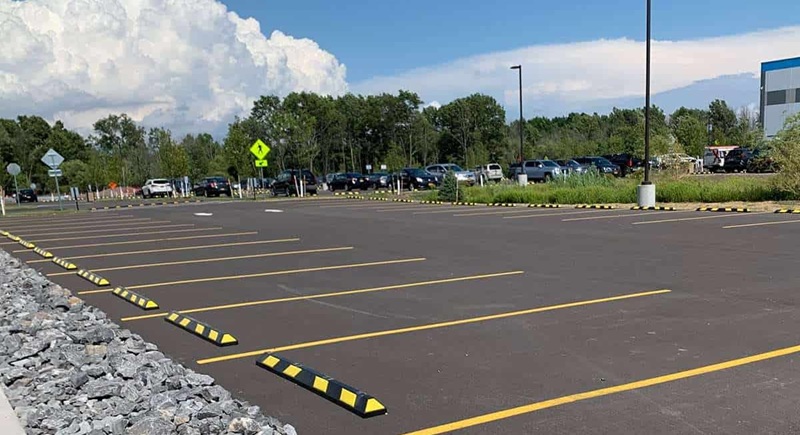
Parking bumpers can be particularly useful when parking spaces are located near structures, sidewalks, landscaping, pedestrian paths, curbs, or other areas that should not be contacted by vehicles.
Why Parking Bumpers Matter
A parking lot needs more than sufficient pavement. It also needs features that help organize movement and protect surrounding property.
Without a defined stopping point, some drivers may pull too far forward into a sidewalk, landscaping area, wall, or other structure. Even at low speeds, repeated contact can cause damage over time.
Parking bumpers provide an additional layer of physical guidance. They can help drivers recognize the front boundary of a parking space while creating separation between vehicles and nearby features.
Their benefits can include:
- Helping define the end of parking spaces
- Reducing vehicle overrun into protected areas
- Protecting curbs, sidewalks, landscaping, and structures
- Creating a more consistent parking arrangement
- Supporting safer and more organized parking areas
Improve Parking Lot Safety
Safety is one of the biggest considerations when designing and maintaining a parking area. Vehicles often operate close to pedestrians, shopping carts, buildings, landscaping, and other obstacles.
Parking bumpers can help establish a predictable stopping position. When drivers know where a vehicle should stop, there is less uncertainty about how far forward they should travel.
This can be especially valuable in busy commercial parking lots. Drivers may be focused on finding an available space, watching other vehicles, or looking for pedestrians. A clearly visible bumper provides an additional physical cue that the parking position has reached its intended limit.
Parking bumpers are not a replacement for responsible driving, appropriate pavement markings, lighting, signage, or other safety measures. Instead, they work as one component of a well-planned parking environment.
Protect Buildings and Other Structures
Parking spaces are sometimes positioned close to buildings. Without an effective stopping barrier, a vehicle may travel farther forward than intended.
Even a minor impact can damage exterior walls, doors, posts, railings, signs, or other property features. Repeated incidents can lead to ongoing maintenance costs.
Properly positioned parking bumpers can create separation between vehicles and nearby structures. They give drivers a physical stopping reference before the front of a vehicle reaches a protected area.
The exact placement should be carefully considered so the bumper provides useful protection without creating an unnecessary obstacle for pedestrians or vehicle occupants.
Protect Landscaping and Pedestrian Areas
Landscaped areas can make commercial and residential properties more attractive, but they can also be vulnerable to vehicles that pull too far forward.
Parking bumpers can help protect grass, plants, decorative landscaping, and other features located at the front of parking spaces.
They can also help distinguish parking areas from sidewalks or pedestrian routes. However, proper layout is important. Bumpers should be installed in a way that does not create unnecessary tripping hazards or obstruct pedestrian movement.
A well-planned parking area considers both vehicles and people. The goal is to provide clear boundaries without making the environment difficult to navigate.
Parking Bumpers for Commercial Properties
Commercial properties often experience significant parking activity throughout the day. Customers may enter and leave frequently, employees may park for extended periods, and delivery vehicles may use designated areas.
This constant activity increases the importance of organization.
Parking bumpers can help establish consistent stopping points throughout a commercial parking area. When combined with clearly painted parking lines and appropriate traffic markings, they can contribute to a more structured layout.
They may be especially useful near storefronts, sidewalks, landscaped islands, building entrances, and other areas where vehicle overrun could cause problems.
Parking Bumpers for Residential Driveways
Parking bumpers are not limited to large commercial lots. They can also be useful in private and residential parking areas.
A driveway may have limited space between a vehicle and a garage door, fence, wall, landscaping, or property boundary. A bumper can provide a clear stopping point and help prevent a driver from pulling too far forward.
For households with multiple drivers, having a consistent stopping reference can make parking easier. It can also reduce the risk of accidentally contacting nearby property.
The size and placement of a bumper should match the space available. A crowded driveway requires careful consideration so that the bumper improves control rather than creating an obstruction.
Choosing the Right Location
Placement is one of the most important considerations when installing parking bumpers. A bumper should be positioned far enough from nearby structures to provide useful protection while still allowing vehicles to fit comfortably within the parking space.
Several factors should be considered, including the size of typical vehicles, parking-space dimensions, pedestrian pathways, curb locations, drainage areas, and nearby structures.
Incorrect placement can create new problems. For example, a bumper positioned too far forward may provide little protection, while one installed in an inconvenient location could interfere with pedestrians or vehicle access.
Professional planning can help determine the most appropriate location for each parking space.
Parking Bumpers and Pavement Markings Work Together
A parking bumper is most effective when it works with other parking lot features.
Painted parking lines show drivers the width and boundaries of a parking space, while the bumper establishes a physical stopping point. Together, these features can make a parking area easier to understand.
Directional arrows, pedestrian crossings, accessible parking markings, fire lanes, and other pavement markings can further improve organization.
When all of these features are maintained, drivers receive multiple visual and physical cues about how the parking area is intended to be used.
Consider Visibility and Maintenance
Parking bumpers need to remain visible and in good condition. Dirt, debris, weather exposure, vehicle impacts, and general wear can make them harder to see.
If a bumper becomes damaged or shifts from its original position, it may no longer provide the intended protection. Regular inspections can help property managers identify problems before they become more significant.
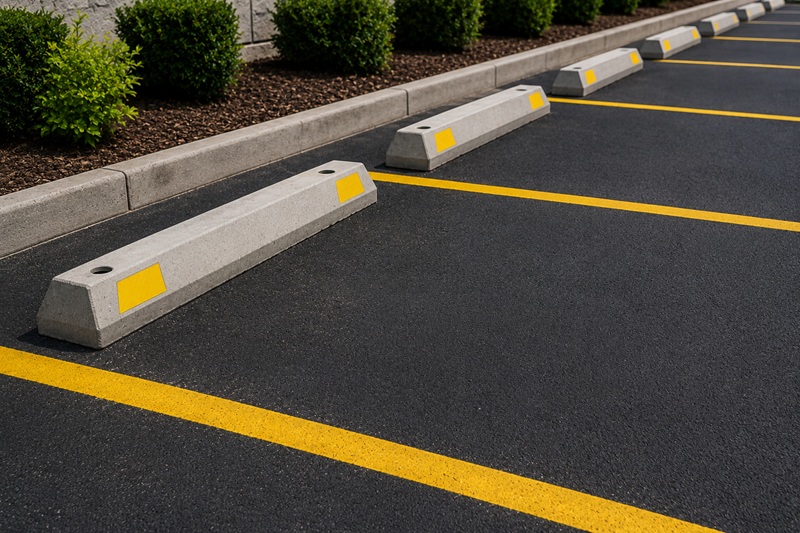
Some properties may also benefit from highly visible bumper treatments so drivers can identify them more easily, particularly in areas with heavy vehicle movement or low visibility.
Keeping the surrounding pavement clean and maintaining nearby parking lines can also make bumpers easier for drivers to recognize.
Common Problems With Poorly Maintained Parking Bumpers
Like other parking lot features, bumpers can deteriorate over time. A damaged or misplaced bumper may not provide the same level of guidance as a properly installed one.
Common issues include cracked or broken bumpers, loose mounting points, faded visibility, displacement after vehicle contact, and poor placement.
Property managers should inspect bumpers during routine parking lot maintenance. If one appears damaged, it should be evaluated rather than simply ignored.
Maintaining individual parking features can help preserve the overall organization of the property.
When Should Parking Bumpers Be Installed?
The need for parking bumpers depends on the design and use of the property. They may be particularly beneficial when parking spaces are directly adjacent to areas that need protection.
Consider them when:
- Vehicles frequently pull too far forward
- Parking spaces are close to buildings or sidewalks
- Landscaping needs protection from vehicle overrun
- Drivers need a consistent stopping point
- Existing parking arrangements have resulted in property damage
A property assessment can help determine whether bumpers would provide a useful addition to the existing parking layout.
Create a More Professional Parking Environment
A parking area communicates something about the property. Faded lines, damaged pavement, poorly positioned vehicles, and missing protective features can create an unorganized appearance.
In contrast, clean pavement, clearly painted spaces, properly positioned parking bumpers, and well-maintained traffic markings create a more professional environment.
For commercial property owners, this appearance can matter to customers and visitors. For residential properties, it can make the parking area easier and more comfortable for residents and guests.
Good parking design combines practical safety measures with visual organization.
Professional Installation Can Make a Difference
Installing parking bumpers may appear straightforward, but placement matters. The bumper needs to be appropriately positioned, securely installed, and compatible with the surrounding pavement and parking configuration.
A professional evaluation can help identify potential conflicts with drainage, pedestrian paths, vehicle dimensions, and existing pavement markings.
It can also help ensure that bumpers are installed consistently across the property. Consistency is particularly important for larger parking lots where multiple spaces need to follow the same layout.
Make Your Parking Area Safer and More Organized
Parking bumpers are a simple but valuable feature for many parking lots and driveways. They help define stopping points, protect surrounding property, support organized parking, and give drivers an additional physical cue when maneuvering into a space.
When combined with properly maintained pavement and clear parking lot markings, they can contribute to a parking environment that is easier to navigate and more professional in appearance.
For property owners in Louisville, Kentucky, Commonwealth Paving can help with parking lot and paving-related needs. To discuss your project, contact Commonwealth Paving at +1 502 459 7283 or visit 136 Outer Loop, Louisville, Kentucky 40214.
Whether you are maintaining a commercial parking lot or improving a private driveway, thoughtful parking design can prevent avoidable problems. With properly selected and positioned parking bumpers, you can create clearer parking boundaries while helping protect the property around them.
How Parking Bumpers Help Prevent Vehicle Damage and Property Collisions
Parking areas are designed to make vehicle access convenient, but they also bring cars, pedestrians, buildings, landscaping, curbs, and other property features into close proximity. Even a slow parking maneuver can result in an unwanted collision when a driver pulls too far forward or misjudges the available space. Repeated minor impacts can eventually lead to costly vehicle repairs and property maintenance.
Parking bumpers provide a simple way to create a defined stopping point inside a parking space. By giving drivers a physical reference for where to stop, they can help reduce the likelihood of vehicles traveling beyond the intended parking area. When properly installed and maintained, parking bumpers can protect nearby structures while helping create a more organized parking environment.
For commercial property owners and managers in Louisville, Kentucky, understanding the role of parking bumpers can be an important part of effective parking lot maintenance. Commonwealth Paving provides professional paving and parking lot services designed to help properties remain functional, organized, and well maintained.
What Are Parking Bumpers?
Parking bumpers are barriers installed at the front of parking spaces to establish a physical stopping point for vehicles. They are typically positioned across the parking stall, perpendicular to the direction in which vehicles enter the space.
When a driver pulls forward, the bumper provides a physical indication that the vehicle has reached the appropriate stopping position. This can be particularly useful when a parking space is located close to a sidewalk, building, landscaped area, fence, curb, or other structure.
Rather than relying entirely on a painted line or visual judgment, the driver receives both a visual and physical reference.
How Parking Bumpers Help Prevent Vehicle Damage
Vehicle damage in parking lots does not always result from high-speed accidents. Small collisions can happen when a driver misjudges the distance between the vehicle and a wall, curb, barrier, or another object.
A properly positioned bumper can limit how far forward a vehicle travels. This may reduce the likelihood of the front tires or vehicle body reaching nearby structures.
Parking bumpers can be especially helpful in spaces where the distance between the vehicle and a protected feature is limited. They create a predictable endpoint and can make it easier for drivers to position their vehicles consistently.
Although parking bumpers cannot prevent every type of parking accident, they can serve as an additional protective feature in a well-designed parking area.
Protect Buildings From Parking Collisions
Buildings located directly beside parking areas can be vulnerable to accidental vehicle impacts. Storefronts, walls, entrances, columns, garage doors, and other structural features may be exposed when parking spaces are positioned close to them.
A driver who pulls too far forward could potentially strike one of these features. Even low-speed impacts may result in damage to exterior surfaces or vehicle components.
Parking bumpers can establish a stopping boundary before the vehicle reaches the protected structure. This can create valuable separation between parked vehicles and buildings.
For commercial properties, this type of protection can help reduce avoidable maintenance problems and preserve the appearance of the property.
Protect Curbs, Sidewalks, and Pedestrian Areas
Parking lots frequently include sidewalks and pedestrian pathways near parking spaces. If vehicles are allowed to extend too far forward, they may block these areas or make contact with curbs and pedestrian infrastructure.
Parking bumpers can help keep vehicles within designated boundaries. By establishing a consistent stopping point, they can reduce vehicle overrun into pedestrian areas.
This is especially important in busy parking lots where customers and employees regularly move between parked vehicles and building entrances.
Proper placement remains essential. A bumper should provide vehicle guidance without creating an unnecessary obstacle for pedestrians.
Reduce Landscaping Damage
Landscaping adds visual appeal to commercial and residential properties, but plants, grass, decorative stones, and landscaped islands can be easily damaged by vehicles.
When drivers pull too far forward, the front of a vehicle may enter a landscaped area. This can damage plants, disturb soil, break irrigation components, or leave tire marks in areas that were designed to remain vehicle-free.
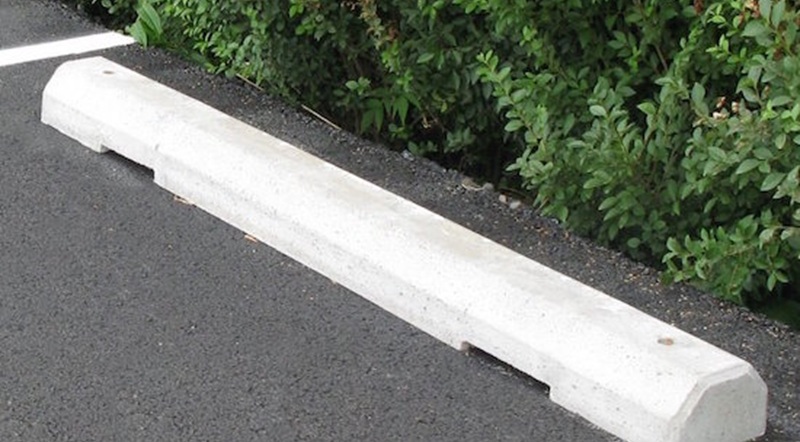
Installing parking bumpers at appropriate locations can help establish a boundary between parking spaces and landscaping. This physical separation can protect attractive property features while keeping vehicles positioned within their designated spaces.
Create a Consistent Stopping Point
One of the biggest advantages of parking bumpers is consistency. Without a physical stopping reference, different drivers may park at different distances from the front of the parking space.
One vehicle may stop several feet behind another, while another driver may pull forward until the vehicle is nearly touching a curb or structure.
Parking bumpers provide a common endpoint. When each parking space has a properly positioned bumper, drivers receive a similar stopping reference throughout the parking area.
This can make the entire parking lot look more orderly while helping maximize the intended use of individual spaces.
Parking Bumpers and Parking Lines Work Together
Parking bumpers should not be viewed as a replacement for pavement markings. Instead, they work particularly well alongside clear parking lines.
Painted lines define the sides of the parking space, while the bumper defines the stopping point. Together, these features create a simple visual and physical framework for parking.
A well-maintained parking area may also include directional arrows, pedestrian crossings, accessible parking markings, fire lanes, and other pavement markings.
When these elements are properly coordinated, drivers have more information about how they should enter, position, and exit a parking space.
Reduce the Risk of Property Collisions
Property collisions can involve more than buildings. Vehicles may accidentally strike signs, light poles, fences, gates, bollards, landscaping features, utility equipment, or other structures.
In spaces where the front of a vehicle approaches these features, a properly installed bumper can provide an additional stopping barrier.
The effectiveness of a bumper depends heavily on its location. If it is installed too far away from the protected feature, it may not provide sufficient separation. If it is installed too close, it may not leave enough room for the vehicle to park comfortably.
This is why parking layout and bumper placement should be evaluated together.
Help Protect Vehicles From Curb Impacts
Parking bumpers can also help drivers avoid certain types of contact with curbs and other pavement features. A driver may not always be able to accurately judge how far the vehicle can move forward, especially when visibility is limited.
A bumper provides a physical reference point. Once the tires reach the bumper, the driver knows the vehicle has reached the intended stopping position.
This can be particularly useful in parking spaces where curbs are elevated or positioned close to the front of the stall.
Useful for High-Traffic Commercial Parking Areas
Commercial parking lots often experience more frequent vehicle movement than private driveways. Customers arrive throughout the day, employees park for extended periods, and delivery or service vehicles may operate around the property.
Higher traffic volume means more opportunities for parking-related mistakes.
Parking bumpers can help establish consistent parking behavior across frequently used spaces. They are particularly useful near entrances, sidewalks, landscaped areas, and structures where accidental vehicle overrun could cause problems.
For property managers, maintaining these features can be a practical part of a larger parking lot maintenance program.
Parking Bumpers for Driveways and Private Parking Areas
The benefits of parking bumpers are not limited to commercial properties. They can also be useful in private driveways and residential parking areas.
A homeowner may want to prevent vehicles from pulling too close to a garage door, fence, wall, landscaping, or another property feature. A properly positioned bumper can provide a clear stopping reference.
This can be especially useful when multiple people use the same driveway. A consistent stopping point can make parking more predictable and reduce the chance of accidentally pulling too far forward.
When Should You Consider Parking Bumpers?
Not every parking space necessarily requires a bumper. They are most valuable where vehicles need a clearly defined stopping point or where property features need additional protection.
You may want to consider parking bumpers when:
- Vehicles frequently pull too far forward
- Parking spaces are close to buildings or sidewalks
- Landscaping is being damaged by parked vehicles
- Drivers have difficulty judging stopping distances
- Curbs, walls, fences, or other structures are vulnerable to impacts
A parking area assessment can help determine where bumpers would provide the most practical benefit.
Proper Installation Is Important
A parking bumper only works effectively when it is installed correctly. Its position should account for the dimensions of the parking space, the types of vehicles using it, pedestrian movement, drainage, and nearby structures.
Improper placement can create its own problems. A bumper that blocks a pedestrian pathway or reduces usable parking space may create an unnecessary hazard.
Consistent installation is also important for larger parking lots. When bumpers are aligned properly from space to space, the parking area looks more professional and functions more predictably.
Inspect and Maintain Parking Bumpers Regularly
Parking bumpers are exposed to weather, vehicle contact, dirt, and general wear. Over time, they may become damaged, loose, displaced, or less visible.
Routine inspections can help identify problems early. Property managers should check whether bumpers remain securely positioned and whether they continue to provide the intended stopping point.
A damaged bumper should not simply be ignored. Replacing or repairing it may help preserve the protective function of the parking space.
Keeping surrounding pavement and parking lines in good condition can also improve overall visibility and organization.
A Simple Feature With Practical Benefits
Parking bumpers may be relatively simple, but their role in a parking area can be significant. They establish a physical stopping point, help prevent vehicle overrun, and create separation between parked vehicles and nearby structures.
By helping protect buildings, sidewalks, landscaping, curbs, and other property features, they can reduce opportunities for avoidable collisions. They can also help drivers park more consistently and contribute to a cleaner, more organized appearance.
The best results come when parking bumpers are incorporated into a complete parking layout that includes properly maintained pavement, visible parking lines, appropriate traffic markings, and safe pedestrian routes.
Protect Your Parking Area With Better Planning
Preventing parking-related damage starts with thoughtful parking lot design and ongoing maintenance. Parking bumpers provide one practical layer of protection by helping drivers recognize where they should stop.
For commercial and residential property owners in Louisville, Kentucky, Commonwealth Paving can help with paving and parking lot improvement needs. To discuss your project, contact Commonwealth Paving at +1 502 459 7283 or visit 136 Outer Loop, Louisville, Kentucky 40214.
A well-planned parking area does more than accommodate vehicles. It protects surrounding property, improves organization, and creates a better experience for everyone who uses the space. With properly positioned parking bumpers, property owners can add a simple but effective feature that helps keep vehicles and surrounding structures safely separated.
Address
Commonwealth Paving, 136 Outerloop, Louisville, Kentucky 40214
Phone: 502-459-7283, Fax: 502-456-2678
Opening Hours
| Monday | 9:00 AM – 5:00 PM |
| Tuesday | 9:00 AM – 5:00 PM |
| Wednesday | 9:00 AM – 5:00 PM |
| Thursday | 9:00 AM – 5:00 PM |
| Friday | 9:00 AM – 5:00 PM |
| Saturday | Closed |
| Sunday | Closed |