
How to Choose the Best Parking Bumpers for Commercial Parking Lots
Commercial parking lots need more than clearly marked spaces and smooth pavement to function effectively. They also need features that help drivers park consistently, protect structures, and create a predictable environment for vehicles and pedestrians. One simple but important feature that can contribute to this goal is the use of parking bumpers.
Parking bumpers, sometimes called wheel stops, are designed to help define the stopping point for vehicles in designated parking spaces. When properly selected and positioned, they can help prevent vehicles from moving too far forward and potentially contacting curbs, walls, landscaping, sidewalks, signs, or other property features.
However, choosing the right parking bumper is not simply a matter of selecting the first available option. Commercial properties have different traffic levels, parking layouts, vehicle types, pavement conditions, and safety considerations. The right choice should fit the property’s specific needs.
For commercial property owners and managers in Louisville, Kentucky, Commonwealth Paving can help with parking lot and pavement improvement needs. To discuss your project, contact Commonwealth Paving at +1 502 459 7283 or visit 136 Outer Loop, Louisville, Kentucky 40214.
What Are Parking Bumpers?
Parking bumpers are physical barriers installed at the front of parking spaces to help control where vehicles stop. They create a visible and physical stopping point for drivers.
In a typical parking space, a bumper may be positioned perpendicular to the vehicle’s direction of travel. When the front tires reach the bumper, the driver receives a physical indication that the vehicle has reached the intended stopping position.
Parking bumpers can be useful in many commercial environments, including office properties, retail parking lots, apartment communities, restaurants, and other facilities with designated vehicle parking.
Their purpose is not to stop a moving vehicle at high speed. Instead, they are intended to help control normal parking movements and establish a consistent stopping point.
Why Commercial Parking Lots Need Parking Bumpers
Commercial parking lots can experience constant vehicle movement throughout the day. Without appropriate stopping controls, vehicles may occasionally travel too far into the front portion of a parking space.
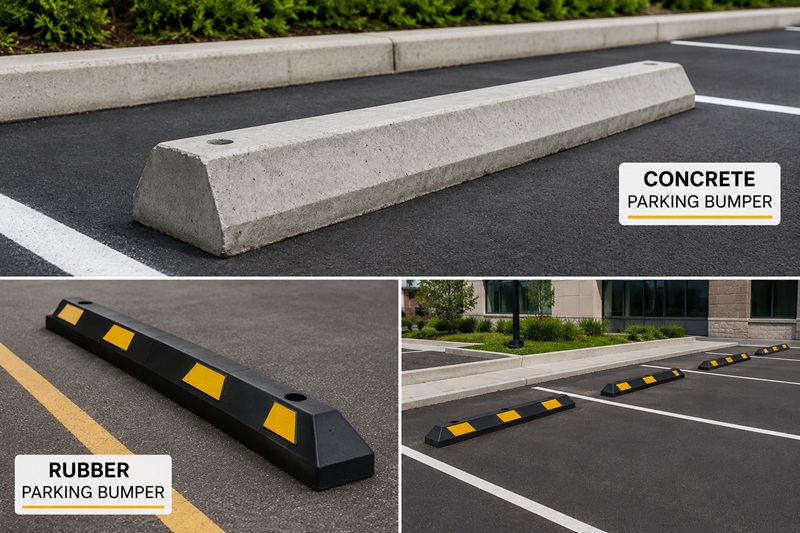
Depending on the layout, this could result in vehicles contacting sidewalks, landscaping, buildings, signs, fences, or other features.
Properly installed parking bumpers can help create separation between parked vehicles and nearby property features.
They can also contribute to a more organized appearance because vehicles are encouraged to stop at a consistent point within each parking space.
Consider the Parking Lot Layout First
Before choosing parking bumpers, examine the layout of the parking lot.
The location of sidewalks, curbs, landscaping, buildings, drainage structures, pedestrian paths, and other features can influence where vehicles should stop.
A bumper that works well in an open parking area may not be appropriate in a space where pedestrians frequently walk directly in front of parked vehicles.
The overall parking design should therefore be considered before selecting and installing parking bumpers.
Think About Vehicle Types
Commercial parking lots can accommodate a wide range of vehicles. A small office parking lot may primarily serve passenger cars, while another property may regularly accommodate SUVs, pickup trucks, vans, or other larger vehicles.
The expected vehicle mix should be considered when selecting parking bumpers.
Large vehicles may have different front-end dimensions and parking characteristics than smaller passenger cars. The bumper’s location should allow vehicles to park effectively without creating unnecessary interference with pedestrians or nearby property features.
Choose Durable Materials
Commercial parking lots generally require durable products because they experience repeated daily use.
Parking bumpers may be manufactured from different materials, each with its own characteristics. Common considerations include resistance to weather, vehicle contact, moisture, temperature changes, and everyday wear.
For a busy commercial property, durability should be a priority. A bumper that deteriorates quickly may need frequent replacement and can make the parking lot look poorly maintained.
When evaluating parking bumpers, consider how frequently the lot is used and what types of vehicles will interact with them.
Consider the Size and Shape
Parking bumpers are available in different dimensions and configurations. The appropriate size depends on the parking space, vehicle types, pavement layout, and nearby features.
A bumper should be large enough to provide a clear stopping point without unnecessarily occupying usable space.
The shape should also be considered from a visibility and functionality perspective.
The goal is to create a physical stopping guide that is easy for drivers to understand while fitting naturally into the parking lot design.
Visibility Is Important
Drivers need to be able to recognize parking bumpers before contacting them. A low-profile bumper that blends completely into the pavement may be difficult to see, particularly in poor lighting.
High-visibility designs can make stopping points easier to identify.
Visibility can be especially important during evening hours, rainy conditions, or periods of heavy traffic.
When selecting parking bumpers, property owners should think about how clearly the bumpers will be seen from the driver’s perspective.
Consider Reflective Features
Some parking bumpers can incorporate reflective elements or other visibility features. These can make the stopping point easier to recognize in low-light conditions.
Commercial properties that operate at night may particularly benefit from enhanced visibility.
The surrounding parking lot lighting should also be considered. Well-positioned lighting combined with visible parking bumpers can make the parking area easier to navigate after dark.
Evaluate the Pavement Condition
The condition of the pavement matters when installing parking bumpers.
Damaged, severely cracked, or unstable pavement may not provide a suitable foundation for secure installation. If the bumper is installed on a deteriorating surface, movement or damage may occur.
Before installation, inspect the pavement beneath and around the intended bumper locations.
If significant pavement problems are present, addressing those issues first may help create a more reliable foundation for the parking lot improvements.
Think About Installation Requirements
Different parking bumpers may require different installation methods. Some are secured directly to the pavement using anchors or other hardware.
The installation method should be appropriate for the pavement type and expected traffic conditions.
Proper installation is just as important as choosing a quality bumper. Even a durable product may perform poorly if it is not securely positioned.
For commercial properties, consistent installation is particularly important because numerous parking spaces may require bumpers.
Space the Bumpers Consistently
Consistency contributes to both appearance and functionality.
When parking bumpers are installed at inconsistent distances or angles, drivers may become uncertain about how to position their vehicles.
A consistent layout creates a more professional appearance and makes the parking area easier to understand.
Before installation, determine appropriate positioning for each row of spaces and account for nearby curbs, sidewalks, landscaping, and other features.
Protect Pedestrian Areas
One of the important reasons to use parking bumpers is to help separate vehicles from areas where people may walk.
However, the bumper itself should not create a pedestrian hazard.
The parking layout should provide adequate space for people to move safely around parked vehicles. Bumpers should be positioned thoughtfully so they do not unnecessarily obstruct walking paths.
Property owners should consider the entire pedestrian route rather than looking only at the vehicle stopping point.
Consider Accessibility
Accessible parking spaces require careful planning. Parking bumpers should not interfere with designated access aisles, accessible routes, or other required features.
The layout of accessible spaces should comply with applicable requirements, and the positioning of any bumper should support the intended design.
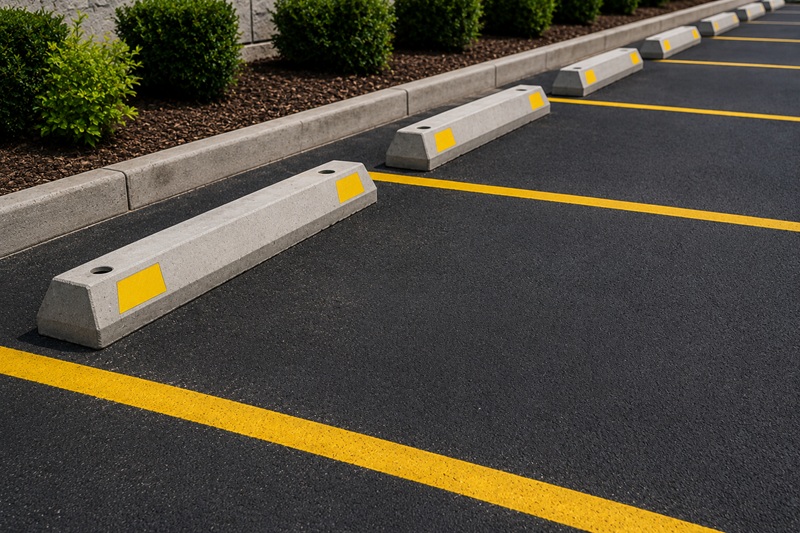
Before installing parking bumpers in accessible parking areas, property owners should verify that the proposed placement does not restrict required access.
Think About Drainage
Parking lot drainage should never be overlooked.
Water needs to move through the property without becoming trapped behind obstacles or accumulating in parking spaces.
When placing parking bumpers, consider nearby drainage paths, low areas, slopes, and water flow.
Poorly positioned bumpers could potentially interfere with drainage or make cleaning and maintenance more difficult.
The best parking lot design considers parking control and water management together.
Avoid Using Bumpers as a Substitute for Good Design
Parking bumpers are useful, but they should not be expected to solve every parking lot problem.
If vehicles regularly travel too quickly, park incorrectly, or move through confusing traffic patterns, the property may need additional visual guidance such as pavement markings and directional signs.
Similarly, if vehicles are consistently contacting buildings or other structures, the overall parking layout may need evaluation.
Parking bumpers should be viewed as one component of a larger parking lot design.
Consider Heavy-Duty Applications
Some commercial properties experience substantially more vehicle activity than others. Locations with frequent truck, van, or SUV traffic may require particularly durable parking bumpers and stronger installation methods.
Property owners should consider the types of vehicles using the lot and how frequently spaces are occupied.
A product suitable for occasional passenger-car use may not necessarily be the best choice for a high-traffic commercial environment.
Match Bumpers to Parking Space Dimensions
Parking spaces vary in size and configuration. Before installing bumpers, review the dimensions of the spaces and the vehicles expected to use them.
The bumper should be positioned to provide an effective stopping point without unnecessarily reducing the usable parking area.
This is especially important in smaller spaces where a few inches can influence vehicle maneuverability.
Careful planning can help ensure that parking bumpers improve organization without creating unnecessary restrictions.
Consider Weather Exposure
Outdoor parking bumpers are exposed to the same weather conditions as the parking lot itself. Rain, sunlight, temperature changes, moisture, and seasonal conditions can contribute to wear.
Commercial properties should choose products appropriate for their local environment.
Louisville properties experience changing conditions throughout the year, so weather resistance should be part of the selection process.
Durability becomes particularly important when bumpers are expected to remain outdoors for many years.
Keep the Parking Lot Organized
One of the simplest benefits of parking bumpers is visual consistency. When vehicles stop at similar positions, parking spaces can appear more orderly.
This can make it easier for drivers to maneuver through the lot and can improve the overall appearance of the property.
A clean parking lot with aligned spaces, visible markings, properly positioned bumpers, and clear traffic routes creates a more professional impression.
Inspect Existing Parking Bumpers Regularly
Even durable bumpers can eventually become damaged or loose.
Property managers should periodically inspect installed bumpers for cracks, movement, missing hardware, fading visibility, or other signs of deterioration.
Damaged bumpers should not simply be ignored. A loose or broken bumper may no longer provide the intended stopping guidance and could become a maintenance concern.
Regular inspection can help property owners identify replacement needs before multiple spaces are affected.
Signs That Parking Bumpers Need Replacement
A parking bumper may need attention when it becomes visibly damaged or no longer remains securely positioned.
Property owners should watch for:
- Cracks, breaks, or severe surface deterioration
- Loose or missing installation hardware
- Bumpers that have shifted from their intended position
- Reduced visibility
- Damage caused by repeated vehicle contact
- Installation areas affected by pavement deterioration
Addressing these problems promptly can help maintain a consistent and organized parking environment.
Combine Bumpers With Clear Pavement Markings
Parking bumpers work best when they are integrated with a clearly marked parking layout.
Fresh parking lines show drivers where spaces begin and end, while bumpers provide a physical stopping reference.
Together, these features can create a more understandable parking environment.
If the pavement markings have faded, refreshing them can complement the installation or replacement of parking bumpers.
Think About Long-Term Maintenance
Choosing parking bumpers should involve more than the initial purchase or installation cost.
Consider how long the product is expected to last, how easily damaged units can be replaced, and whether the parking lot can be maintained without major disruption.
A durable, appropriately installed product may provide better long-term value than a lower-cost option that requires frequent replacement.
Professional Planning Can Improve Results
Commercial parking lots often contain many individual spaces, making consistency especially important.
Professional planning can help determine appropriate bumper locations while considering traffic flow, pedestrian routes, pavement condition, drainage, accessibility, and property features.
This broader approach helps ensure that parking bumpers become part of a functional parking lot design rather than isolated additions.
Choosing the Right Parking Bumpers for Your Property
The best parking bumpers for a commercial parking lot are those that match the property’s traffic, pavement, layout, vehicle types, visibility requirements, and long-term maintenance goals.
Before making a selection, consider:
- Expected vehicle types and traffic volume
- Bumper material and durability
- Size and visibility
- Installation method
- Parking space dimensions
- Pedestrian and accessible routes
- Drainage and pavement condition
- Long-term maintenance requirements
Taking time to evaluate these factors can help property owners avoid choosing products that are unsuitable for the parking environment.
Professional Parking Lot Services in Louisville
Parking bumpers are relatively simple features, but their placement and condition can influence how effectively a commercial parking lot functions. Proper selection, positioning, installation, and maintenance can help create a more organized environment while helping separate vehicles from nearby property features.
For commercial property owners in Louisville, Kentucky, Commonwealth Paving can assist with parking lot and pavement improvement needs. To discuss your project, contact Commonwealth Paving at +1 502 459 7283 or visit 136 Outer Loop, Louisville, Kentucky 40214.
Create a Safer, More Organized Parking Lot
Choosing the right parking bumpers is about more than finding a physical barrier for each parking space. The right products should complement the property’s layout, accommodate expected vehicles, remain visible, withstand outdoor conditions, and be installed in locations that support both vehicle and pedestrian movement.
Property owners should also remember that bumpers work best as part of a complete parking lot maintenance strategy. Clear pavement markings, appropriate traffic flow, good drainage, accessible routes, and well-maintained pavement all contribute to a more functional property.
With careful planning and regular inspections, parking bumpers can provide a practical way to establish consistent stopping points, protect surrounding features, and improve the overall organization of commercial parking spaces. When combined with professional pavement maintenance, they can contribute to a parking lot that looks cleaner, functions more effectively, and provides a better experience for customers, employees, and visitors.
Parking Bumpers vs Wheel Stops: Understanding the Key Differences
Commercial parking lots rely on a combination of pavement, markings, traffic controls, and physical features to create an organized environment. Among the most common features used to control where vehicles stop are parking bumpers and wheel stops. Although these terms are sometimes used interchangeably, property owners may encounter different designs, installation methods, and applications when selecting products for a parking area.
Understanding the differences can make it easier to determine what works best for a particular driveway or commercial parking lot. The right choice depends on the parking layout, vehicle types, surrounding structures, pedestrian areas, pavement condition, drainage, visibility, and long-term maintenance expectations.
Both parking bumpers and wheel stops can serve as physical stopping guides. However, selecting and positioning them correctly is essential. They should complement the overall parking lot design rather than be treated as standalone solutions.
For property owners in Louisville, Kentucky, Commonwealth Paving can assist with parking lot and pavement improvement needs. To discuss your project, contact Commonwealth Paving at +1 502 459 7283 or visit 136 Outer Loop, Louisville, Kentucky 40214.
What Are Parking Bumpers?
Parking bumpers are physical barriers placed within or at the front of parking spaces to provide drivers with a clear stopping point. They can help prevent vehicles from moving too far forward within a space.
Depending on the design, parking bumpers may be constructed from durable materials designed to withstand repeated contact, weather exposure, and everyday parking activity.
Their primary purpose is to provide a physical reference for drivers while helping create consistency across a parking lot.
For example, if parking spaces are located directly beside a sidewalk, landscaping area, or other feature, a properly positioned bumper can help establish a predictable stopping point.
What Are Wheel Stops?
Wheel stops serve a similar basic function. They are designed to contact a vehicle’s tires and indicate that the vehicle has reached the intended stopping position.
The term “wheel stop” generally describes the function rather than a single specific product design. Different wheel stops may vary in material, shape, dimensions, visibility, and installation method.
Because of this, the terms parking bumpers and wheel stops may sometimes be used to describe similar products.
The important consideration is not simply the name but how the product is designed, installed, and used within the specific parking environment.
Why the Terms Can Be Confusing
One reason property owners may find these terms confusing is that there is no universal distinction between them in everyday parking lot conversations.
A product marketed as a parking bumper may perform essentially the same stopping function as a wheel stop. Another product may have a different shape or installation system while still being designed to control the forward position of a parked vehicle.
Therefore, comparing the physical characteristics and intended application is usually more useful than focusing solely on terminology.
The Primary Purpose of Both
The fundamental purpose of both parking bumpers and wheel stops is to establish a stopping point for vehicles.
They can help prevent drivers from pulling too far forward into areas such as:
- Sidewalks
- Landscaped sections
- Building entrances
- Pedestrian paths
- Fences
- Signs
- Other designated property features
Properly positioned parking bumpers can create a more predictable parking arrangement and help maintain separation between parked vehicles and nearby areas.
Material Is an Important Difference
One of the most meaningful differences between individual parking bumper products can be the material used in their construction.
Commercial parking areas require products capable of handling repeated outdoor exposure and vehicle contact. Materials may vary in durability, weight, flexibility, appearance, and resistance to weather.
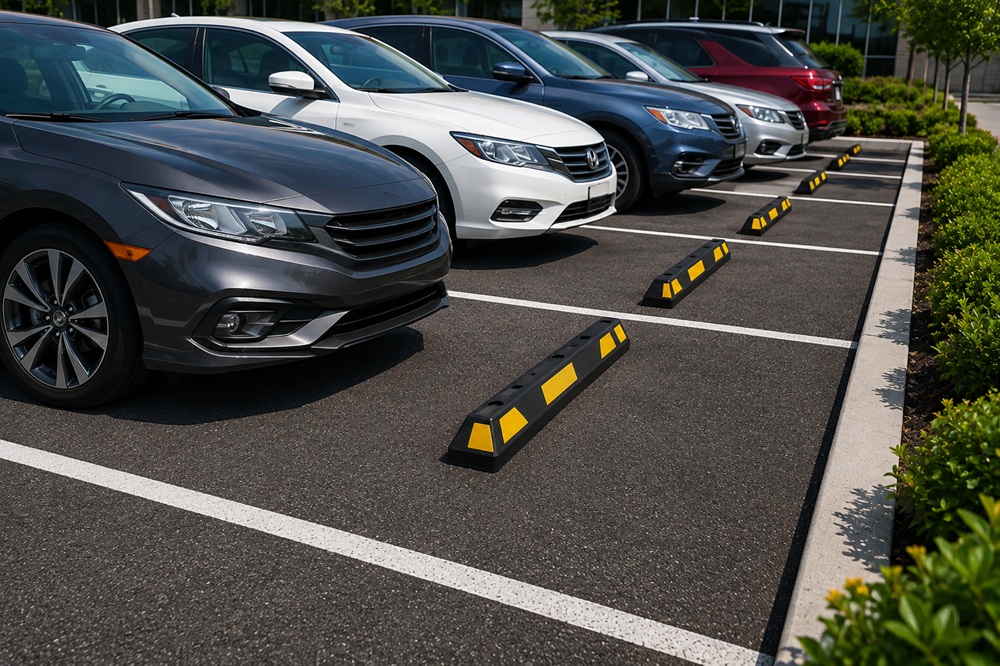
When comparing parking bumpers and wheel stops, property owners should consider the expected traffic and environmental conditions rather than choosing based only on appearance.
A heavily used commercial lot may require a more durable solution than a lightly used parking area.
Concrete Wheel Stops vs Other Options
Concrete wheel stops can provide substantial weight and stability. Their heavier construction can make them resistant to movement when properly installed.
However, concrete can also be rigid and may crack or deteriorate if repeatedly struck by vehicles or exposed to certain environmental conditions.
Other parking bumper designs may offer different characteristics, such as easier handling or replacement.
The appropriate choice depends on the property’s needs and how the parking spaces are configured.
Visibility Matters
A stopping barrier should be easy for drivers to see. Low-visibility features may be difficult to identify, especially at night or during poor weather.
Visible parking bumpers can provide drivers with a clearer visual reference before the vehicle reaches the stopping point.
Reflective elements or contrasting finishes may improve visibility, depending on the product and property design.
Lighting should also be considered. Even highly visible bumpers can become difficult to recognize if the parking lot has inadequate nighttime illumination.
Installation Method Makes a Difference
Parking bumpers and wheel stops can use different installation methods. Some are secured directly to the pavement with anchors or other hardware.
The installation method should be compatible with the pavement and the expected traffic conditions.
Proper installation is important because a bumper that shifts or becomes loose may no longer provide the intended stopping function.
For commercial properties with many spaces, consistent installation also contributes to a cleaner and more professional appearance.
Consider Your Parking Lot Pavement
The condition of the pavement should be evaluated before installing either parking bumpers or wheel stops.
If asphalt is severely cracked, deteriorated, or unstable, installing a bumper directly onto the damaged surface may not produce the desired long-term result.
A stable pavement surface provides a better foundation for installation.
Property owners should inspect the intended installation areas and address significant pavement problems when necessary.
Parking Bumpers Can Help Protect Property Features
One of the practical benefits of parking bumpers is that they can help establish separation between vehicles and nearby property features.
A vehicle that moves too far forward may contact a curb, wall, fence, landscaping, sign, or other structure.
A properly positioned stopping barrier can help reduce the likelihood of vehicles reaching those features during normal parking movements.
However, bumpers should not be considered a guarantee against vehicle collisions. They are intended as parking guides and physical stopping references, not high-speed barriers.
Wheel Stops Can Support Consistent Parking
When wheel stops are positioned consistently, they can encourage vehicles to stop at similar locations.
This can make rows of parked vehicles look more organized and can help maintain predictable spacing between vehicles and nearby features.
Consistent positioning is particularly important in larger commercial parking lots where numerous spaces need to function together.
Consider Pedestrian Movement
Parking lot design should account for pedestrians as well as vehicles.
A bumper placed too close to a walkway can interfere with pedestrian movement or create an obstacle. The stopping point should be positioned with the entire parking layout in mind.
When comparing parking bumpers and wheel stops, consider where people walk after leaving their vehicles and how the physical barrier will affect those routes.
Accessible Parking Requires Careful Planning
Accessible parking spaces require appropriate dimensions, access aisles, and routes. Any parking bumper or wheel stop installed in these spaces should be positioned so that it does not interfere with required accessibility features.
Property owners should ensure that their parking layout follows applicable accessibility requirements.
A product that works well in a standard parking space may require different positioning or consideration in an accessible space.
Drainage Should Not Be Overlooked
Water needs to move through a parking lot efficiently. Standing water can damage pavement and create maintenance problems.
When installing parking bumpers, property owners should consider drainage paths and low areas. Bumpers should not be positioned in ways that unnecessarily obstruct water movement.
A complete parking lot evaluation should consider pavement, parking spaces, drainage, pedestrian routes, and physical barriers together.
Consider Vehicle Size
The right stopping point depends partly on the vehicles using the parking lot.
A property serving compact passenger cars may have different needs from a commercial parking area used by pickup trucks, SUVs, vans, or other larger vehicles.
Vehicle dimensions should be considered when determining the appropriate location of parking bumpers or wheel stops.
The goal is to provide a useful stopping reference without unnecessarily limiting the usable space within the parking area.
Think About Traffic Volume
High-traffic parking lots place more demands on physical parking features.
Frequent vehicle movement and repeated contact can cause poorly selected or improperly installed products to deteriorate more quickly.
When comparing parking bumpers and wheel stops, consider how many vehicles use the property each day and whether certain spaces experience substantially heavier traffic.
High-use areas may benefit from durable products and careful installation.
Appearance Can Influence the Choice
Parking lot features are highly visible. A row of damaged, misaligned, or deteriorated wheel stops can make an otherwise well-maintained property look neglected.
Property owners should consider how the chosen product will look alongside the pavement, landscaping, parking lines, curbs, and buildings.
Clean, consistently positioned parking bumpers can contribute to a more professional appearance.
Maintenance and Replacement
No parking feature lasts forever. Vehicle impacts, weather, pavement movement, and general aging can eventually cause damage.
Property managers should inspect wheel stops and parking bumpers periodically.
Look for:
- Cracks or broken sections
- Loose anchors or hardware
- Shifting or misaligned units
- Fading or reduced visibility
- Damage caused by vehicle contact
- Pavement deterioration around installation points
Replacing damaged units promptly can help maintain a consistent parking layout.
Which Option Is Better?
There is no universal answer to whether parking bumpers or wheel stops are better. In many situations, the terminology may describe products that perform essentially the same basic function.
Instead of choosing based on the name alone, evaluate the actual product characteristics and the property’s needs.
Consider durability, material, visibility, installation, vehicle traffic, parking space dimensions, pedestrian routes, accessibility, drainage, and maintenance.
The best solution is the one that integrates effectively into the overall parking lot design.
Avoid Using Physical Stops as the Only Traffic Control
Parking bumpers and wheel stops are useful, but they should work alongside other parking lot features.
Clear pavement markings can show where vehicles should park. Directional arrows can guide traffic. Signs can communicate restrictions. Pedestrian crossings can identify areas where people cross vehicle lanes.
A coordinated approach creates a more understandable parking environment.
Parking bumpers should therefore be viewed as one part of a complete parking lot management strategy.
When to Replace Existing Parking Bumpers
Property owners should consider replacing existing units when they are cracked, broken, loose, severely faded, or no longer positioned correctly.
Repeated vehicle impacts may gradually move a bumper away from its intended location.
If several units throughout the parking lot show similar deterioration, it may be useful to evaluate the entire installation rather than replacing only the most visibly damaged unit.
Professional Parking Lot Planning in Louisville
The distinction between parking bumpers and wheel stops is often less important than understanding what the specific product is designed to do. Both can provide physical stopping guidance, but materials, dimensions, visibility, installation methods, and durability can vary.
For property owners in Louisville, Kentucky, Commonwealth Paving can assist with parking lot and pavement improvement projects. To discuss your property needs, contact Commonwealth Paving at +1 502 459 7283 or visit 136 Outer Loop, Louisville, Kentucky 40214.
Make the Right Choice for Your Parking Lot
When comparing parking bumpers and wheel stops, focus on function rather than terminology. Both can help establish consistent stopping points and provide separation between vehicles and nearby property features.
The right choice depends on the property’s layout, traffic volume, vehicle types, pavement condition, visibility requirements, pedestrian routes, accessibility considerations, drainage, and maintenance expectations.
Well-positioned parking bumpers can contribute to a cleaner and more organized parking lot when they are incorporated into a thoughtful overall design. Combined with clear pavement markings, appropriate traffic flow, good drainage, and regular maintenance, they can help create a parking environment that is easier for drivers and pedestrians to understand.
For commercial property owners, investing time in proper planning can make parking lot improvements more effective and long-lasting. Whether you call them parking bumpers or wheel stops, the goal remains the same: create clearly defined stopping points that support an organized, functional, and well-maintained parking area.
Address
Commonwealth Paving, 136 Outerloop, Louisville, Kentucky 40214
Phone: 502-459-7283, Fax: 502-456-2678
Opening Hours
| Monday | 9:00 AM – 5:00 PM |
| Tuesday | 9:00 AM – 5:00 PM |
| Wednesday | 9:00 AM – 5:00 PM |
| Thursday | 9:00 AM – 5:00 PM |
| Friday | 9:00 AM – 5:00 PM |
| Saturday | Closed |
| Sunday | Closed |